
DURING the First World War (1914-1918) Sphagnum moss was used extensively in the preparation of wound dressings. At this time there were no antibiotics and limited chemical antiseptic treatments like iodine or potassium permanganate and sepsis was common. Sphagnum moss, which contains antiseptic iodine, also helps to heal wounds by keeping them dry. It has remarkable absorbent qualities, holding up to twenty-five times its own weight of fluid, and absorbs fluids three times faster than cotton. Wounds treated with moss were found to heal much faster than wounds bandaged with cotton. The wartime demand for surgical dressings was enormous, as an average of 30 dressings was required for each patient. The heavy demand for cotton gauze therefore threatened to exhaust the supply, so in 1915 sphagnum moss was approved as a substitute. By 1916 the War Office had officially listed sphagnum moss as an appropriate dressing, and when the armistice was signed on November 11, 1918, more than a million bags of moss were being prepared each month throughout the country. The moss was collected from peat bogs in the British Isles by volunteers, as individuals or groups, who worked on the moors or lived in the nearby villages. Dartmoor's bogs and mires support twelve species of sphagnum moss which, due to their great absorbency, help to trap water and so maintain the bog habitats. Dartmoor was one of the sites for collecting the moss, which was deposited in local centres in Tavistock and Mary Tavy, co-ordinated from the headquarters at Princetown. This was located in the former Imperial Hotel and called the Duke of Cornwall's Sphagnum Moss Depot. The Prince of Wales (later to briefly become King Edward VIII) was the sponsor and patron, and as the elder son of the reigning monarch he was also the Duke of Cornwall. The Princetown depot was the regional headquarters and employed between 30 and 40 people, cleaning and sorting moss and preparing the dressings. The moss was thoroughly dried, suspended in a heated drying room, and weighed. The moss dressing was simply dried moss in a muslin bag and required no sewing. One hundred sacks of dried moss and 500 prepared dressings were sent weekly from this depot for hospital service in the south, Midlands and overseas. One of the Prince's visits to the depot on February 23, 1918 was reported in the Times. He had equipped the depot himself and maintained it at his own expense and his support was greatly appreciated by the local people. The Prince met Mrs Read, who co-ordinated the 40 workers who were processing the moss. In recognition of their service the Prince issued the workers with a badge with a fleur-de-lys embossed in gold, surrounded by a dark blue garland, surmounted by a crown in red and gold. That day the Prince also visited Mount Tavy, now a school, but was then a hospital for wounded servicemen. At Mary Tavy, five miles from Tavistock, a Mrs Groser managed the workers at the local depot, who collected the sphagnum moss from Dartmoor. Rakes were used to gather the moss into small piles, before sorting it into baskets and taking it back to the depot, which could be a considerable distance. Mrs Groser therefore went to Port Isaac in Cornwall to buy a donkey and cart for this purpose, a distance of 40 miles from Mary Tavy. Driving the donkey and cart back to Mary Tavy caused some passing interest and sympathy for the reason for her journey. When she stayed overnight at an inn near Davidstow, the landlord gave her the room free and fed the donkey. At Mary Tavy the moss was sorted, cleaned and either dried in the open, or temporarily stored in a shed belonging to a Mr Collins, and then dried in the local Reading Room. There was also a local moss depot at the Bedford building (most likely part of the now Bedford hotel buildings) in Tavistock, where the moss was dried. At Okehampton members of the Bible class helped gather the moss. A Mr T Dick had diligently gathered 200 sacksful in two months. A Mr John Durant had collected 1,000 lbs of moss by mid-1916, mainly from around Yes Tor, using a specially made rake and walking 800 miles during the collecting expeditions. Collection of sphagnum moss for the preparation of wound dressings was therefore a major contribution on the home front in Devon during the First World War. At Widecombe there is a memorial shell donated in 1920 by the National War Savings Committee, which commemorates the efforts of the local people in collecting the sphagnum moss from Dartmoor. Ironically it was a German surgeon who in 1881 had published a paper describing the healing properties of moss in the treatment of wounds. The French War department employed it in 1895 and in 1915 as a standard dressing. Dried moss's absorbent and natural antiseptic iodine has been known and used for treating wounds for thousands of years. In 1014 a Gaelic Chronicle reported the wounded at the battle of Clontarf stuffed their wounds with moss, and in 1513 Scottish soldiers also used moss for wounds at the battle of Flodden. In 1991 the body of a 5,000 year old iceman was found in the Alps on the border between Italy and Austria. Analysis of the remains showed that moss may have been used then as a dressing for one of his wounds. • Dr Pulsford will be giving a talk at The Wharf, Tavistock on Edward VIII and his mistresses on Monday, June 23 at 2pm. Entrance £5 or £4 for Friends of the Wharf members.
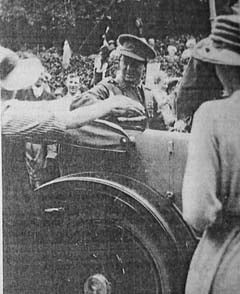
Edwrd VIII, the sponsor and patron of the spagnum moss collection depot on Dartmoor, pictured during a visit to Kelly OTC in 1919.



More About:
Comments
This article has no comments yet. Be the first to leave a comment.