
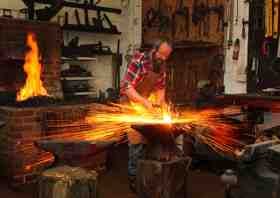
HAND forged in Princetown last week was an historic cobra head boundary marker destined to be placed at Eylesbarrow on Dartmoor.
The traditional art of forging the wrought iron post was completed by Gary Sharman, blacksmith at Princetown Forge.
The making of the cobra head boundary marker was part funded by the Dartmoor National Park Authority and the Duchy of Cornwall, to replace the one that had disappeared from Eylesbarrow.
In 1867 four iron posts, resembling cobra heads, were erected in a straight line from Great Mis Tor to North Hessary Tor and South Hessary to Eylesbarrow, to mark out the Walkhampton boundary.


-found-by-the-roadside.png?width=209&height=140&crop=209:145,smart&quality=75)
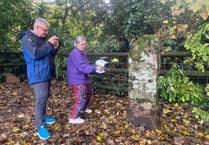
Since then the Great Mis Tor post has been replaced by an army flagpole used to fly the red warning flag whilst firing is taking place, the North Hessary post hole has been covered by a triangulation point and the South Hessary cobra head was recently repaired and replaced by the national park authority.
The post at Eylesbarrow had been repaired by the national park but was broken off and removed in 2014 by vandals despite the post having no monetary value.
Jane Marchand, senior archaeologist of the DNPA involved in the project to replace the iron post, said the new marker would be fixed into its original position affixed to a rock sited between the two prehistoric burial cairns on the crest of the hill.
'From an archaeological point of view all the boundary markers, which define the Forest of Dartmoor, are historically important as they help to preserve the whole history behind the creation of the Forest of Dartmoor and have been used as reference points when carrying out the perambulation of the forest over many hundreds of centuries,' she said.
'Although the cobra heads only date back to the 19th century they are important as they are the result of a boundary dispute, are unique in their style and of course only two out of the original four now survive and are well known features on Dartmoor.'
Assistant head ranger for the DNPA works team Jon Stones said: 'We will put the cobra head in a big granite boulder and we will be careful not to interfere with the archaeological setting at Eylesbarrow due to the cairns.'
In order to replace the missing post with wrought iron, which is hard to come by, an old railway track lever was found and forged to resemble a cobra's head. Wrought iron does not rust and can withstand the Dartmoor environment.
The Forest of Dartmoor originally belonged to the Crown and was known as Forest, as it comprised the King's hunting ground.
In 1337 it was granted to the Black Prince, who was also the Duke of Cornwall, by his father King Edward III and has remained part of the Duchy of Cornwall's holdings since then.
The forest lies within the parish of Lydford and adjoins 21 other parishes with a boundary which is marked by numerous boundary stones and natural features.
A number of perambulations have taken place over the centuries to mark out the boundary; the earliest recorded one was in 1240. In that year, Henry III despatched 12 of his knights to ride on horseback around the boundary to record certain fixed points on the route.
The boundary between the Forest and Walkhampton Manor, which by the 19th century was the property of the Lopes family, was the subject of historic discussion. It was questioned whether the boundary from Elysburge/Ellisborough, nowadays known as Eylesbarrow, should continue to Plym Head or Plym Steps.
In 1851, Lord Morley yielded to the claim of the Duchy and agreed that the boundary should be considered from Deadlake Foot to Mistor and Ellisborough to Plym Steps. To mark the boundary, bound posts were prepared and fixed, with flag poles erected in holes.
Sixteen years later the four iron posts resembling a cobra with a flattened head were erected from Great Mis Tor to North Hessary Tor and South Hessary Tor to Eylesbarrow.
The posts were recorded in the OS Boundary remark book of 1881, in which sketches show their exact location.
All crosses were inscribed with FB (forest bounds) on the east facing side and WB (Walkhampton bounds) on the west facing side.
Comments
This article has no comments yet. Be the first to leave a comment.