
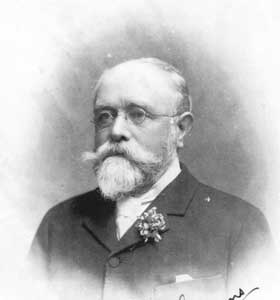
THE huge generosity of a businessman born in Victorian England has had a lasting impact on Okehampton, and his legacy has helped to preserve many of the town's most recognisable features.
Sydney Simmons was born on September 10 1840 in Okehampton, in a cottage which now stands today as the Victorian Pantry tearoom in the Museum of Dartmoor Life's courtyard.
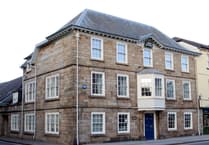
His parents, Thomas and Elizabeth Simmons, ran a printing and stationery business in the building opposite to the cottage Sydney was born in.
In around 1846 Sydney was sent away to a private school in Lincolnshire where he stayed for around five years.
He returned to Okehampton in 1851 following the death of his father.
Sydney's mother, brother and two sisters Mary Ann and Sophia stayed in Okehampton to run the family printing business, while Sydney moved to Devonport in Plymouth.
While there he took up an apprenticeship with a drapery firm and in 1862 at the age of 22 he moved to London to work for a carpet manufacturing company.
That same year, Simmons was sent to North America as a sales representative for the carpet company. He travelled the United States and Canada for a decade, and during this time he acquired the rights to a mechanical process for cleaning carpets.
In 1888 he returned to London, buying a house in Finchley which he named after his hometown, Okehampton.
Sydney got married and formed two companies, the Patent Steam Carpet Beating Company and the Compressed Air Carpet and Tapestry Cleaning Company.
Their success made him a rich man.
During the following years Simmons often visited Okehampton to see friends and relatives, never forgetting the town of his birth.
By the turn of the century he had become an incredibly wealthy man and five years later he started to buy up land in Okehampton.
His first purchase was a field in East Street in 1905 for the purpose of building some almshouses – charitable housing provided to enable poor people of a locality to stay in their community.
Beside the East Ockment river there was an area called Jole's Meadow and Jole's Bere Wood. The meadow and wood was already a beauty spot and favourite playground for the town's children. Coming onto the market in 1905, Okehampton Town Council bought the land to prevent it being built on.
They bought the land for £1,000 on a mortgage from Dingley and Pearse's Bank, and then applied for a loan of £1,250 from the Local Government Board to pay for the laying out of the park.
When this application was turned down, Mr Simmons stepped in.
He offered to buy the land from the council, and gift the park to the people of Okehampton and lay out the park at his own expense provided he was allowed a free hand in its design.
It included the building of five almshouses, one which still stands to this day as Chalet Treloar. Simmons spent £3,000 on landscaping the park, a huge sum at the time, with the town council covering the cost of the park's gates and railings.
The park was opened to the public on July 8 1907 by the Lord Mayor of London, the Right Honourable Sir William Treloar, and Chalet Treloar was named in his honour.
In 1910, Simmons gave Friary Park in Finchley to the people of London at a personal cost of £7,000.
Simmons Park was one of a handful in Devon to receive the Queen Elizabeth II Diamond Jubilee seal in 2013, given out by Fields in Trust to recognise the enduring quality of the park as a recreational space for the town.
In 1911 Simmons bought Okehampton Castle and the medieval deer park surrounding it, and spent the next few years removing the vegetation from the ruin and repointed the masonry.
The grounds were laid out with path and seats for people to enjoy. In 1917 the site was given to the town with £1,000 invested for its upkeep.
The castle is now looked after by English Heritage, and is open to the public in the spring and summer months.
He was also the largest stakeholder in Okehampton Golf Club when it opened in 1913, and gave a gift of £500 to the town council to carry out work on recreation grounds at Kempley Meadows.
The golf club still thrives today, with a top quality 18 hole course.
Mr Simmons died on April 29, 1924, but his generosity endured after his death, leaving £10,000 in his will to pay for the construction of almshouses on the site in East Street he had purchased back in 1905. They opened in 1939.
Mr Simmons' generosity was best described by Sir William Treloar, Lord Mayor of London, who said 'He is a man who has the head to make money, and the heart to give it away.'
l The information in this feature was taken from a pamphlet published to celebrate Simmons Park's centenary in 2007. Information on Sydney Simmons and his life was researched and collated by Paul Rendell, Christine Marsh and Gill Lower.
Pictures by Tom French
Comments
This article has no comments yet. Be the first to leave a comment.