
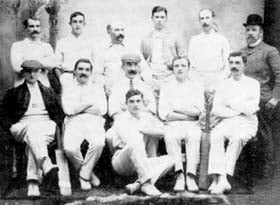
CONTINUING in its series looking at the history of West Devon sporting clubs Times Sport turns the spotlight on Tavistock Cricket Club.
-looking-festive-with-other-runners-at-TACs-monthly-Tavistock-5km--Pict.jpeg?width=209&height=140&crop=209:145,smart&quality=75)


ONE of the Devon's oldest clubs, Tavistock Cricket Club first set up its stumps in 1849 and 165 years later it is still not out and heading confidently towards its double century. According to local historian Gerry Woodcock's excellent book A History of Tavistock Cricket Club 1849-1999 cricket was played before 1846 in the town at Crowndale, now the site of Tavistock College, but there was no club cricket. However, in the summer of 1849, the seventh Duke of Bedford (the brother of the Prime Minister of the time, Lord John Russell), who owned most of the town, agreed that cricket could be played at Whitchurch Down. The site, known as the Ring, has around 50 stones which surround the cricket field - in days long gone ponies would be tied to brass hooks inserted into the stones when the monks from the nearby abbey held a pony market there. The seventh duke and his friends played cricket there and gradually the club evolved and in April 1860 it was decided 'to erect a wood house on the ground to accommodate members'. It was ready for the first match of the season. A side from Okehampton were entertained to lunch in the new pavilion. However, gales in 1872 blew it down before a second pavilion was built the following year. Cricket matches for the first hundred years consisted of local contests between 'gentlemen v players' before the net widened with the club playing friendlies against other 'local sides' such as Plymouth, Yelverton, Launceston, Exmouth, Exeter and Torquay. Tavistock entertained many touring sides from cricketing counties such as Surrey, Sussex and Yorkshire, who enjoyed coming down to Devon and playing on a cricket pitch on 'the wilds of Dartmoor'. Bill Alley, the Somerset and England player and later an international umpire, hit a record breaking 3,000 county runs in one season — that year he came to the Ring and hit 70 before declaring the pitch 'as the best he had played on in the country all season'. Only the two world wars interrupted the friendly but competitive matches although matches were played at the Ring despite the lack of manpower. In 1953 Hastings Russell, the 12th Duke of Bedford, died accidently as a result of a gunshot wound in the grounds of his Endsleigh estate. Because of the enormous death duties his family had to pay, the deeds of the club were passed to the club itself at a peppercorn rent of sixpence (two and a half pence today) to be paid to Tavistock Town Council for 100 years. The long connection with the Russell family continues as the heirs of the Dukes of Bedford have always had the honorary position of club president. It was not until 1972 that Tavistock formally joined the newly formed Devon League; although the club has endured and enjoyed mixed fortunes on the field there have been some notable successes in the premier league in the late 1980s and 2007 along with a Devon Senior Cup success in 1971 and 1985. One amusing incident recalled in Gerry Woodcock's book is the story of Gloucester player David Shepherd (who still holds the record of umpiring the most test matches, 92). 'Shep' lost his wicket in unusual circumstances. Stuart Munday, the current president and a stalwart of the club for more 50 years, had marked out the pitch as 23 yards instead of the standard 22 yards. The result, to David Shepherd's eternal exasperation, was that the county player took a quick single and found himself run out — by a yard! Another amusing tale that caused a bit of a stink at the time was when in 1975 police inspector Peter Anderson was captain he wanted to avoid problems with ponies galloping across the square. He was advised that tiger manure from Plymouth Zoo was the answer. It certainly kept the ponies away but also burnt the grass on the square and this took a long time to recover! Following the end of the Second World War Tavistock had an ageing side and in the mid to late 50s Gordon and Rex Parry, Frank Millman, Jack Davey's father Eric, David Gordon, Maurice Avery and Ken Jarman all retired from cricket. This left a number of new younger players, including Eric Jarman who was captain for many years, Bob Elliott, Jack Rogers and Budleigh Davey to continue the fortunes of the club. The early 1960s saw the rise of another batch of good young players, namely Roger Jephcott, Pearce Bickley, Jack Davey, Maurice Craze, Dave Ewings, Stuart Munday, Derrick Pethick, Peter Earl, Roger Quick, Geoff Husband and Bob Quick. The last few years have seen many changes with good players being lost to universities, leaving David Manning and Shaun Daymond to develop an ever changing team. Currently the side appears to be heading for promotion to the Devon Cricket league. With special thanks to Stuart Munday and also local historian Gerry Woodcock and author of 'A History of Tavistock Cricket Club 1849-1999'.
Comments
This article has no comments yet. Be the first to leave a comment.