

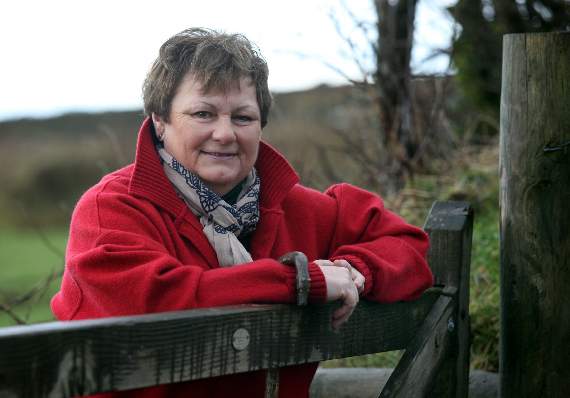
Observations on Dartmoor life by farmer Mary Alford
The brilliant weather that we have had in September and October, with the hedges full of berries with plenty of sloes to go with the gin and the lovely colours of the leaves on the trees, has made working on the farm a pleasure.
With a good harvest behind us and the livestock enjoying the climate and loving the sun on their backs, hopefully we go into winter in good condition and well prepared.
The good weather sometimes makes you forget that we are now into November.


Time marches on and waits for no one but we are now heading downhill towards the Christmas and New Year period, which is a ghastly thought!
In the farming calendar that means getting organised for when the weather breaks and the rain comes and the sheds have to be ready to house the cattle right through until the end of March — at least. Every day that we are able to keep the cattle outdoors, even with some supplementary feed is a bonus, so fingers crossed for a few more weeks.
Mild in the wild
Autumn calving has been in full swing for the last eight weeks and the dry weather conditions have been a bonus. The calves born on the moor are a joy to see but usually quite wild.
I always think they are one of the nearest examples this country has of animals being born in a wilderness where the mother cow gives birth and generally hides their young away.
In this case it is likely to be in a ‘hollow’ or in a gorse patch in order to protect them from predators, which includes humans as well.
The cows and young calves can sometimes be a bit of a challenge when they have to be brought in off the moor onto the farm and housed for the winter because the calves have never seen a gateway or fences to restrain them and their mothers can become very protective.
When the cows are with their young calves they are wary of dogs so walkers with dogs on the moor should be careful when you are near them.
Everyone has been busy with the autumn sheep sales. Tupping time is fast approaching and the rams will be put to work.
The general rule of thumb is that the higher the altitude of your farm the later you can lamb the ewes, so putting the rams in with the ewes has to fall in with that calendar.
It is no good going against nature and you need to lamb the ewes in the spring when the weather hopefully warms up again and the grass begins to grow.
We should be coming out of winter when the ewes lamb with hopefully a sign of grass to boost the mother’s milk for the lambs and less need of supplementary feed.
Most of the pony gathering has taken place but there are still a few areas on parts of Dartmoor to gather and this will continue up until next February.
Declining numbers
The ponies continue to decline in number as more pony keepers give up their herds through lack of financial income and the ever increasing paperwork that is put upon us to present the foals at the sales. The pony sale at Chagford market was good this year and thanks must go to Rendells the auctioneers and to the Dartmoor Hill Pony Association for organising and running the event. Also a big thankyou to Mr Arnold from Moorgate veterinary practice, who is the vet who does all the micro chipping of the semi-feral foals on the day – not an easy task and without all those people working together the sale just would not happen.
New regulations making us complete silhouettes in addition to microchipping the ponies before they left the sale yard was the biggest hurdle we had to get over this year. The question has been asked of DEFRA that they insist on microchipping which is a digital identification, so why do we also have to draw silhouettes of each pony? It is very difficult to see all the colour markings on a semi feral foal and the markings can change when the foal gets older.
The Dartmoor Hill Pony Association has invited the people who make these decisions at DEFRA, based in London, to visit Dartmoor. We look forward to their visit when we hope they will be able to complete the silhouette forms with perfection with the white markings on the ponies drawn and hatched in pen, plus the colour of eyes etc.
I must admit I failed the test as I didn’t read the small print. I did the white markings fairly well and I thought fairly neatly and hatched in with a black pen - unfortunately I failed because I did it in the wrong colour pen as it should have been red! So that was the sin I committed and I had to do the whole process again – a lesson learnt – Read the small print!
I think you must now get the picture of the frustrating red tape we again have to go through. Will BREXIT change all that? Time will tell but many meetings organised by the NFU and the CLA (Country Landowners’ Assocition) are being held with MPs on ’could do, won’t do, and maybe’ but we all hope for free trade and less regulations being on a big wish list. I think there will be an interesting couple of years ahead.
Drive with moor care
The big down side of grazing animals on the moor is the ever increasing number of incidents of road traffic accidents (RTA). The Dartmoor Commoners Council’s welfare officer Karla McKechnie produced figures at our last meeting for this year up to October 19 and they are shocking.
To date this year there have been 145 animals killed on Dartmoor roads, being 118 sheep, 24 ponies and three cows plus 21 injured animals and the worst incident was when 15 sheep were killed in one accident. The true number will be higher — animals injured in unreported RTA’s very often die in the bracken and are never found.
We still have two and a half months of this year left and more numbers will be unfortunately added to the total with darker evenings coming and with the usual fog in November it does not look good. The most annoying facts are that the motorists involved in the RTA’S are usually local people, not the tourists. The number of animals lost equate to the number of animals that would generally stock a small farm. What a sad loss of animals — for no other reason than driving much too fast on the moor!
From RTAs to RPAs
Frustration still continues over payments to upland farmers, including Dartmoor, from EU schemes.
We met the chief executive, Mark Grimshaw, of the Rural Payments Agency (RPA) in August and discussions included the six-year back payment which should have been paid last August but was agreed to be paid by the end of October 2016 target, which has not been met and payment statements to all farmers showing how the calculations will be made were due by the end of September and this target was also not met.
According to Mr Grimshaw the new computer system appears unable to produce information needed so I ask — how do the RPA calculate our payments? So, the meeting with him was a waste of time.
The payment system works whereby the UK government pays its dues to the EU for all its contributions, including agriculture, then claims back part, including the agricultural contribution to pay the UK farmers. However, if all the payments due to farmers have not been completed by the date being October 16 this year, then the UK has to pay a large fine to the EU. So, the UK taxpayer actually pays twice because of the incompetence of the RPA and the UK treasury loses out — a double whammy.
With the 2016 payment window opening on December 1, 2016 Mr Grimshaw told us he was confident the payment would improve but with the 2015 payment still not completed how can we have confidence in the RPA at all. I really cannot think of any more excuses that the RPA can make — perhaps the quill pen has run out of ink!
Comments
This article has no comments yet. Be the first to leave a comment.