
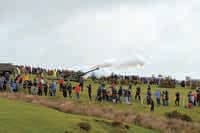
TEENAGERS taking part in the Ten Tors Challenge across the moor rose to the occasion this weekend, defeating wet conditions on Dartmoor. Around 2,400 teenagers aged 14 to 19 took part in Ten Tors, one of the toughest challenges for youngsters in Britain. The youngsters trek up to 55 miles unaided across the moor as part of a team, taking on some of the toughest terrain and highest peaks in Southern England relying on their navigational skills and carrying all their food, water, bedding, tents and other essentials as they go. A further 300 youngsters with physical or educational needs took part in the Jubilee Challenge. Ten Tors is one of the biggest multi-agency, tri-service civil contingency exercises in Britain. It is run by more than 900 military personnel — almost all of them Reservists — from all three branches of the Armed Forces, led by the Army's 43 (Wessex) Brigade. Brigadier Piers Hankinson MBE, director of Ten Tors and Commander of the 43 (Wessex) Brigade, said: 'It makes it all worth it, to these those teams come in, see them stride in, there's a team of six, and it's all about teamwork, self confidence. 'The conditions out on Dartmoor were really tough. The 35 mile teams are teenagers, 14 or 15 years old, and it is great that they do this. It is wonderful that the Army leads this, supported by the Navy Air Force. We do this for youth development and it is fantastic to be a part of all this.' This year's Ten Tors saw the first changes to the challenge's routes for 30 years, with fewer river crossings, reducing the need for air support in bad weather. The changes come following the mass evacuation during storms at the 2007 event, and stood up to arduous conditions during this year's events. Brigadier Hankinson said: 'We've introduced a number of new ideas, innovations, practices and procedures to enhance the safety and also to improve the resilience of the challenge. 'When I looked at this exactly three years ago after my first Ten Tors, it struck me we were hostage to the weather, unnecessarily in certain places. Particularly with rising water levels, some of the water obstacles up there, which become quite major rivers further downstream, if the water rises it puts the whole challenge at risk. 'Some of the roads, particularly around Princetown, 30 years ago probably weren't very busy. Why would we now put 14 or 15 year olds along a route that takes them across a road? We have changed that. We have improved it. It is just as challenging as it ever has been. 'We have all been slightly apprehensive as to the reality and whether it would be challenging enough. And it's proved as equally challenging as before. The fact the first teams are coming in at around 9 o'clock proves it is just as do-able but also as challenging as it was, but also much more resilient to the weather.' With the arduous weather conditions, the challenge claimed a high number of drop-outs this year, with around 280 participants having to pull out, mostly due to the usual sprains and strains seen each year at the event.



Comments
This article has no comments yet. Be the first to leave a comment.