
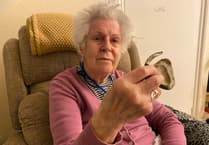
BETTY Batchelor is an 82-year-old white-haired lady with a ready smile. She loves cards, knitting, a spot of painting . . .
But behind that image lurks a sharp political intellect — Betty has a wealth of experience and the sort of contacts any aspiring politician would give their eye-teeth for.
Any aspiring Labour politician that is — for Betty is a socialist through and through.
'It has been a way of life for me, it was natural because I have been brought up in that field. I had a very happy and liberal upbringing but we also had very good standards,' she said.



'I was encouraged by my parents to take part in anything that was worthwhile — but I was never allowed to join the Brownies or Guides because my dad didn't believe in the King!'
She was born in 1918 and brought up in Plymouth, but has always had close links with Tavistock.
Her mother's family came from the Chillaton area. Young Betty would spend school holidays at grandmother's house — and every Friday her mother would come to Tavistock to meet her sister and shop in the town.
'I had the best of both worlds — I had the country life from my mother's side of the family and the city and sea from my father's,' she said.
Betty was introduced to politics from an early age, canvassing with her parents, leafleting houses — the hub of her social life being Devonport Victory Hall, now the Labour Club.
'My mum and dad were both politically involved, so I grew up with a political background — also, my aunt was a very emancipated lady.'
It was during those early days that Betty first began to make contact with political activists — personalities who later became cabinet ministers, MPs and leaders of councils.
'I got to know Michael Foot in the 1930s — I was also there when he was our Devonport candidate in the1945 election and was very much involved in his campaign,' she said.
It's a relationship which has stood the test of time and distance, kept strong by shared beliefs and interests — the Labour Party and Plymouth Argyle!
'I would meet Michael very often at away matches if Argyle were playing at Fulham,' Betty recalled.
She was personally invited to the recent memorial service for Mr Foot's wife, Jill Craigie, taking her place with leading Labour figures, past and present.
Betty was one of just 12 out of 300 pupils to pass the entrance exam to the Co-op in Plymouth, where she opted to learn a trade, working in the ironmongery department.
Her technical talents influenced her war work, when she was employed by the Post Office's engineering department, eventually being seconded to the defence telegraph network at Mount Wise in Plymouth.
Betty married her husband Len in 1943 and after the war settled to life as a housewife, but still accompanying her mother to political meetings.
Her first chance to put her Labour beliefs into practice was when she was co-opted to Plymouth City Council in 1950 — her first election victory came in 1956.
'You were thrown in at the deep end, you never started with a winnable seat, you were "blooded" first.'
She soon made her mark.
'As a woman member on the council you were expected to be on the welfare, education or children's committees — when a vacancy on the works committee came up I said "I'd like to do that".
'I broke the ground and was the first woman to stand on that committee.'
When Len's health deteriorated, Betty thought about working again.
After a chance conversation with a fellow councillor, Betty became lady supervisor in the packing department of baby food manufacturers Farleys in Plymouth.
'When I first took on the job, it became apparent that pressure of work meant the staff were having to work perhaps as long as 12 hours a day and that wasn't acceptable as a permanent thing,' she said.
She was asked to investigate the possibilities of women working an evening shift — a ground-breaking idea, bearing in mind few married women worked at the time.
Soon she had 20 ladies manning what became known as the 'granny shift'.
At her instigation, a nurse was employed to look after first aid at the factory — an embryonic health and safety policy.
She also made sure that a certain amount of less able workers were taken on annually — an equal opportunities policy ahead of its time.
A radical firm at the time, Farleys allowed Betty to carry on her public role.
'I found having a political background was never a hindrance to working in industry — it was complementary,' she said.
Her mother loomed large at home, as Betty and Len shared a house after the family home was destroyed during the Blitz.
Betty lost her seats on the county and city councils in 1977, at around the same time that her mother died.
These factors contributed to Betty and Len's move to Tavistock in 1978. She was determined to devote more time to her husband, who had suffered many years of ill-health.
But retirement from Farleys and large authorities didn't stop Betty for long. The first thing she did after moving to Tavistock was join the local Labour party — in 1983 she won a town council seat as a Labour candidate, spending a year in office as mayor in 1995.
During her long and active life she has been involved in many political changes — so what does she think of New Labour?
'I have reservations, but I think it is necessary for the times.'
She said she remembered listening to the wartime Home Secretary, Labour politician Herbert Morrison.
'He said: "You can say what you like, you can do what you like, but you can't do anything without power". You have to have the power first.'
Betty has some regrets — but these are tempered with a typically positive outlook.
'I regret not having had a family but by not having one I have been able to devote myself to looking after other people's problems. It's given me more time to make it a priority to look further than my own four walls.
'One of my joys is that a number of people have turned round and said to me that I started them off on their career — I love to encourage people.
'If you believe in a thing passionately you must stand your corner and fight for it — that's always been my yardstick.'