
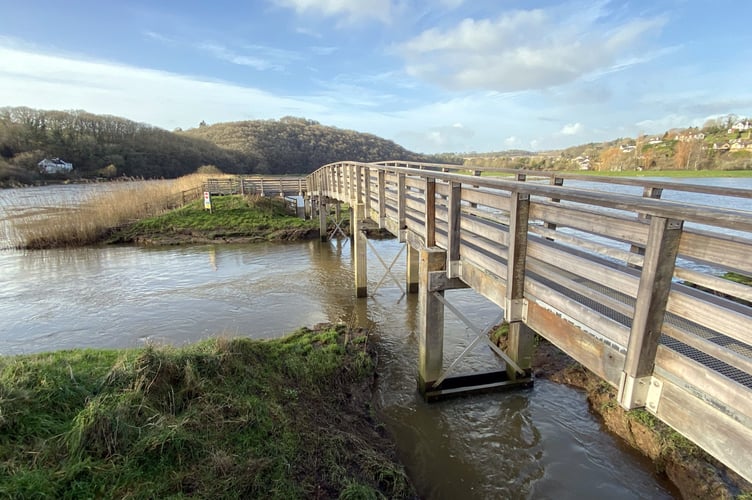
COUNCILLORs have ‘grave’ concerns following discussion of a report highlighting erosion concerns that could have implications for the integrity and safety of the new footbridge and the footpath at Calstock wetlands.
The geomorphological report commissioned by the Environment Agency last year was brought up at the last Calstock Parish Council meeting by Councillor Alastair Tinto who voiced concerns over the findings of the report and the council taking any responsibility or ownership of the bridge until these ‘risks’ have been resolved.
The report stated that ‘significant’ erosion of the breach had taken place and that this erosion is likely to continue for ‘several years’. AECOM also observed that the ‘short term or long term mitigation measures that may be required to protect the structure need to be advised and developed by bridge engineers.’
In May 2022, the Environment Agency commissioned AECOM, a consultancy agency, to conduct the report as a result of ‘observations of a potentially developing risk’. The risk was that there was ‘scour’, the term used in the report to describe erosion that was occurring to the breach.



AECOM delivered their report in July 2022 and the main findings included rapid acceleration in the erosion rate of the breach in May and June ‘almost fully exposing the eastern bridge pile’ and that the scour had slowed down but would continue until ‘a new equilibrium was reached’. The report also stated that this erosion could potentially ‘place assests at risk.’ The erosion fears were brought up at the council meeting with councillors expressing particular concern over the exposure of the bridge piles and how this could affect the structure. Within the report it is mentioned that the breach channel will continute to erode vertically downwards two metres below the bottom of the bridge piles (the concrete posts driven into the ground to support the bridge). The breach channel is also going to continue to erode laterally by 10m and on the western side by 6m.
Cllr Alastair Tinto said: ‘The erosion will continue vertically until it’s two metres below the bottom of the piles. So the piles will be exposed right at the bottom. The question is really what are the piles going to rest on? If the pile caps are exposed will that mean the bridge is going to collapse?
These concerns were echoed by Cllr Wilkes who said: ‘It is going to fail. That bridge is going to be down somewhere round Plymouth in a couple of years.’
Cllr Tinto brought the report to the attention of full council over concerns of the council’s involvement with the ownership of the bridge. The parties involved are the Environment Agency, The Tamar Community (TCT) Trust and the Calstock Parish Council.
‘At the moment, the Environment Agency own the bridge and the river walk’, said Cllr Tinto. However, before the bridge was built it was discussed that the TCT would take responsibility for the bridge and footpath and that the council would be the backstop owner if the TCT folded. However, the lease and the discussion of who the responsibility of the bridge falls to are ongoing.
‘There we have in black and white in an official document that there are major concerns,’ said Cllr Tinto. ‘So long as there are concerns about the integrity and safety of the bridge and the footpath, and until the new equilibrium is reached in several years, I have grave concerns about the parish council taking on responsibility for or ownership of the bridge or the footpath.’
In July AECOM and the bridge pile designers agreed there was ‘no immediate risk to the structure, but careful ongoing monitoring is required’.
Jane Kiely, chair of the TCT said: ‘TCT is not in a position to discuss the AECOM report at this stage as the situation is ongoing and discussions between all the parties need to happen in order to see a way forward, before any statements are made.’
An Environment Agency spokesperson said: ‘The EA is continuing to work with our local partners and consultants to determine current and potential future risks and mitigation associated with the footbridge over the wetland inlet breach. At this time, there is no significant risk to the bridge so it and the footpath remain open.’
Comments
This article has no comments yet. Be the first to leave a comment.