
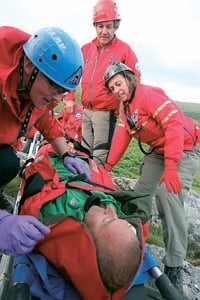
DARTMOOR Search and Rescue exists to help the police and other related rescue organisations to locate, render appropriate assistance and evacuate missing persons to a place of safety. All team members are highly trained in a variety of skills ranging from first aid through to navigation, searching techniques and radio operation. Its services are entirely voluntary — and in high demand in situations where weather conditions are poor and the location of the missing person is unknown. Individual search teams are co-ordinated through a team leader who is in constant radio contact with the controller co-ordinating the search effort. It works closely with the police who initiate calls to DSR team members in situations where its services may be required. Tavistock is one of four teams which make up the DSRT group. The Dartmoor Rescue Group was formed in Tavistock in 1968, to help provide efficient search and rescue facilities for the police. The team is recognised by the Mountain Rescue Council which represents all mountain rescue teams in England and Wales. Nearly 40 years later, DSRT continues to provide support to search for, treat and evacuate people lost or injured, not just on Dartmoor, but anywhere it is needed. Now based in Ashburton, Okehampton, Plymouth and Tavistock, nearly 200 volunteers are available to answer call-outs at all hours and in all weather conditions. Until recently the team was one charity, but changed a few years ago when it became self governing. Each team was renamed Dartmoor Search and Rescue Team followed by the name of its home base. The Dartmoor Rescue Group still exists but is now an executive committee whose primary role is to oversee the liaison between the four DSRT's, made up from representatives of all four teams. DSRT (Tavistock) is called out by the police when there is some reason to believe that one or more persons may be missing or injured on Dartmoor or any other area the police may require assistance. The controller is the person who plans and co-ordinates any search and rescue operation. They will then get the call out co-ordinator to send a text message to team members informing them that there is a call out. The message would contain details of the rendezvous (RV) point and basic information of the task. Team members would then head for the RV. Upon arrival the control vehicle and rescue equipment for deployment is organised During this time the controller (or search manager) would plan the search area, and as more people arrive teams would start deploying to their areas. The hasty and search dog teams would be given areas suited to their specialist skills, and depending on the nature of the call out, the controller may call in other DSRT's to assist or request other support services from the police. On locating the casualty the team would carry out necessary medical care before deciding the best way to evacuate — by helicopter, Land Rover or stretcher. Mountain Rescue across England and Wales is a voluntary service and DSRT receives no government funding for its work. Agencies the teams work with include the coastguard, the ambulance service, fire brigade and the RNLI. In good weather an aircraft like the air ambulance or police helicopter will often be used to evacuate an injured person. The police helicopter may also be used for searching. However, the weather on Dartmoor can make searching by helicopter impossible. In these situations it is down the the members of the DSRT and their dogs to be on the ground, which is why DSRT call outs are often on misty nights when it is raining.



Comments
This article has no comments yet. Be the first to leave a comment.