

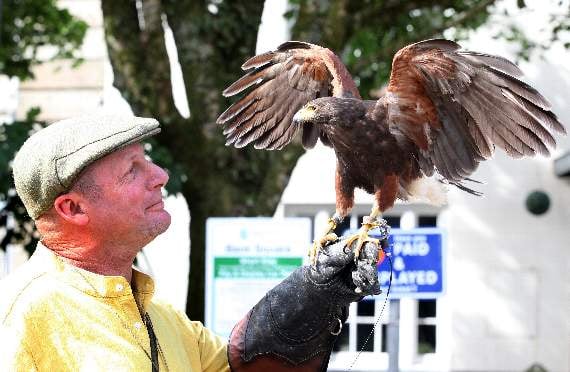
SHOPPERS in Tavistock may have been surprised to see a hawk flying in and around the town recently — in an attempt to tackle the feral pigeon problem.
Hoodoo the Harris Hawk has been attracting lots of attention in the Bank Square area recently as local falconer David Buncle of Westcountry Falconry has been employed to modify the behaviour of local feral pidgeons whose numbers have increased to the point where their droppings can present potential health and safety hazards.
Tavistock has had a recurring problem with pigeon numbers over the years, most notably in the Bedford Square area, where the main concern was droppings on people sat on the benches outside the town hall.
Tavistock Town Council has put in place measures in the past to tackle this problem but the increase in pigeon numbers comes in cycles and is said to be affected by whether they are being fed by members of the public.
-with-daughter-Ada-and-fr.jpeg?width=209&height=140&crop=209:145,smart&quality=75)

David and Hoodoo have been recruited by a local business responsible for the maintenance and upkeep of some of the premises around Bank Square. Previous efforts to manage the issue with netting and anti-perching spikes and even the use of a life-like plastic model owl have proved ineffective.
David said: ‘Though Hoodoo is unlikely to outfly a healthy pigeon, they soon learn to view the area as less attractive for nesting, roosting and foraging.
I find that for areas where night-time roosting causes substantial fouling problems, the sight of old Beau the eagle-owl at dusk usually encourages the pigeons to reconsider their choice of night quarters.
David said the specialised use of trained birds to manage this sort of situation in an environmentally sensitive fashion, has recently begun to become more widely known.
‘I have been working in a very wide range of sites needing this sort of service since 1980, when I spent a couple of years providing falconry-based bird control on military airfields on behalf of the United States Airforce.
‘Like most apparently simple trades there’s a lot more to it than one might imagine — every job is different and I enjoy the challenge of working in varied locations throughout the South West.
‘The birds are all individuals and while some will be better than others for a particular mission, I’m constantly aiming to encourage them to develop and improve their skills.’
Hoodoo and his flying colleagues have worked in the area on and off for a number of years and currently visit the Bank Square site several times a week.
‘I have noticed that in most towns experiencing rapid pigeon population increases, to the levels where management is called for, there will be some deliberate feeding by people — with the best intentions — removing what would otherwise be the most significant limiting factor to population growth, for a species that can breed all year round due to its association with artificially heated buildings as nesting sites.
‘Feral pigeons, the majority of which are descended from uncompetitive racing pigeons, do very well foraging for food without any extra help.
David continued: ‘Feeding garden birds on the other hand, is of immeasurable benefit to not just the individual feeder, but the whole surrounding ecosystem!’
Comments
This article has no comments yet. Be the first to leave a comment.