
A 'WONDERFULLY rich and compelling account' of West Country soldiers at peace and at war — that is an academic accolade of Jeremy Archer's 'The Old Westcountry Regiments'.
His well researched book is clearly 'a labour of love' — he served in the Devonshire and Dorset Regiment between 1974-83 and his father, General Sir John Archer, was a former Colonel of the regiment.
'The Old Westcountry Regiments' — relating to the former county regiments of Devon and Dorset — covers the period from the Battle of Plassey in 1757 (between the British and the French in India) and the Battle of the Somme in 1916.
In his foreword Saul David, Professor of War Studies at the University of Buckingham, perhaps captures the spirit of the book: 'It is not a regimental history, but rather a series of snapshots from the century and a half that separated the battles of Plassey (1757) and the Somme (1916). Where possible he has striven to record the ordinary Tommy's experience, and the end result is a wonderfully rich and compelling account of West Country soldiers at peace and at war.'

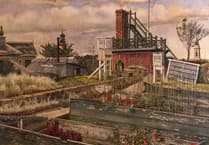


November 11 (Armistice Day) is a day which will remain fixed in the annuls of the Dorsets. On that day in 1857 a troop ship, the Sarah Sands, caught fire with around 370 of the 54th Foot — later the second battalion, the Dorsetshire Regiment — on board. The ship was on its way from England with troops to reinforce the British forces fighting the Indian mutineers. With powder kegs and 90 barrels of ammunition in each magazine ready to explode at any moment the fight was on to jettison the cargo before it ignited.
... 'While some soldiers emptied the magazines, others dampened down the coal by pouring water through holes in the upper deck planking. This was exhausting and asphyxiating work and many were "brought on deck quite senseless.'"
Private William Wiles and the ship's Quartermaster Richard Richmond, bravely went into the burning saloon to rescue the regimental colours. By the evening the fire had taken firm hold and brought the mizzenmast crashing down. A quick thinking Lance Corporal John McCullum cut through the rigging with the axe, allowing the mast to fall clear of the ship.
... At that stage Captain James Castle believed his ship lost but Major William Freeland Brett assured him —'We shall fight on till driven overboard!'
Despite the efforts the inevitable occured and the flames reached the powder and there was a tremendous explosion.
'After a violent roll and a dramatic dip of the stern, the Sarah Sands somehow righted herself and Captain Gillum was heard to shout:?'She's all right boys, pull away at the pumps.!'
Despite three of the four masts gone overboard and its perilous state the ship survived the fire and elements and eventually limped into St Louis, Mauritius on November 23, 1857 to receive a hero's welcome.
Another date July 1, 1916 — is a a day that will be forever remembered in the annals of British military history, when the British Army suffered the worst one-day combat losses in its history, with almost 60,000 casualties - among them 163 of the 8th and 9th Devons. These men are buried at the Devonshire Regiment Cemetery at Mametz in Picardy, France. One such visitor to the cemetery is former soldier Sir Ray Tindle, the founder and owner of the Tindle Newspaper Group, who said: 'It was my privilege to serve during the Second World War in the old Devonshire Regiment (11th of Foot) and I still have the regimental silver (or part of it anyway!).
'I have been to the field in France, beautifully preserved to this day as the Devonshire Regiment Cemetery. Jeremy Archer's book has on its cover the inscription which I read both before and after I walked along the old trench on the Somme where the Devons who held it are buried. The inscription reads:
'The Devonshires held this trench
The Devonshires hold it still.'
'Ninety-eight per cent of the crosses have the name of a Devon soldier and all have the same date - July I, 1916.'
The wide ranging accounts of this book embrace the early days of the British Indian Empire, the American War of Independence and the Napoleonic, First Burma and Crimean Wars. The regiments were also involved in the colonisation of both South Africa and Australia.
It is a must for anyone with connection to the famous regiments and an absorbing read for those with an interest in Britain's military role in history.
l 'The Old Westcountry Regiments' is published by Pen and Sword of Barnsley and costs £30; limited copies at £20 (or £25.50 including postage and packing) are available through The Keep Military Museum, Bridport Road, Dorchester. Dorset DT1 1RN — call 01305 264066. ISBN 184884512X.
Comments
This article has no comments yet. Be the first to leave a comment.