
DEVON Air Ambulance made emergency trips to snow-bound Princetown three times in two days this week.
An elderly woman was airlifted to hospital out of the village on Friday, after it was considered too dangerous to try and transport her by road.
The temperature in England's highest village plummeted to minus 19c last Thursday night . On Friday morning, a woman resident of Royal Court in Princetown, who is in her 80s, reported feeling unwell and the emergency services were called.
Princetown firefighters, the co-responders who attended Royal Court in their 4x4 rapid response vehicle, supported the woman until the arrival of the air ambulance.
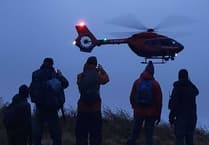



The rescue was caught on camera by a Sky News TV crew, who had been staying in the village.
On Saturday morning, the helicopter was back again, after an elderly woman was taken ill in the Woodville Avenue area of Princetown. Again, Princetown's co-responders proved invaluable, taking the casualty in their 4x4 to Church Field, from where she was flown to hospital.
And the air ambulance returned to the village later in the day, after another elderly resident suffered breathing problems.
Princetown resident Mike Kinsey, who watched the air ambulance arrive in the village on Friday, said: 'The flying skill of the pilot was amazing, he landed in an area no bigger than a tennis court, and can have been largely blind for the last few metres, due to the snow.'
Mr Kinsey said it was 'very reassuring' to know that residents living in remote areas like Princetown could rely on the local fire service and the air ambulance in such extreme weather conditions.
Princetown firefighter John Webber said the village's co-responders had been called out three times last week with their new vehicle.
Mr Webber said: 'It's an all purpose, all year round vehicle. We've already noticed an increase in our response times — we are able to get to addresses a lot quicker than when we were in the fire engine, because of the size and nature of the vehicle.
'When it's a case of going down small lanes and rough tracks and in inclement conditions, it's already proving useful.
'We were also called out to help in the sad case when the canoeist was lost in the water at Dartmeet.'
Mr Webber said the co-responding team had received additional medical training and in any emergency classed as 'category A', the Princetown team could be mobilised.
'In the Princetown area the ambulance would come from Tavistock or Plymouth, but in busy times, it could be from much further afield, so responders support until the arrival of the full ambulance service,' he said.
Devon Air Ambulance chief executive Heléna Holt this week praised the general public for their support.
She said 'The past couple of days haven't been easy, even for the crew on both of Devon's air ambulances.
'Although unaffected by the ice on the roads, the crew do, of course, face the same problems when landing on scene with regard to carrying heavy kit and stretcher to the injured or medically ill.
'Our crews tell us that they have been overwhelmed by the support received on scene by communities, who have helped greatly, whether that's carrying a bag, or indeed helping carry a patient back to the helicopter along a slippy path.
'It really has made such a difference.'
Ms Holt said on just one day last week, Devon's Air Ambulances were called out in excess of seven times.
'The type of missions on the whole fitted into two categories, those who had fallen whilst out, and those with a medical problem such as suspected heart attacks, in rural and hard to reach locations,' she said.
Comments
This article has no comments yet. Be the first to leave a comment.