
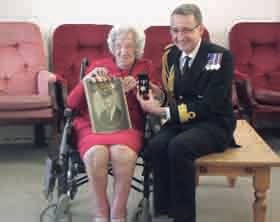
THE 100-year-old widow of a Royal Navy veteran had stars in her eyes last Thursday when she was presented with a medal marking her husband's exploits in the Arctic during the Second World War.
Win Foster, who will be 101 on April 12, received the Arctic Star on behalf of her husband Bert Foster from Commodore Graeme Little, the Commodore of HMS Drake in Plymouth. The presentation brought the former chief stoker's wartime medal tally to nine — including a remarkable six campaign stars.
Introducing Commodore Little to Mrs Foster's many friends and family in attendance was her son Colin Foster.
During his speech he thanked the Navy and everyone present.




Mr Foster said: 'It is a very special occasion and I am very grateful to the commodore for coming.'
He remembered: 'When we would complain about the cold he would say "you don't know cold, go to the Arctic".
'Dad used to say that it was so cold [in the Arctic] they would have to knock the ice off the boats to stop it getting top heavy. He had an eventful life.
'I knew nothing of his other life, he was an ordinary bloke but he was a hero, all were heroes.'
Commodore Little said he was delighted to be able to present the Arctic Star to Mrs Foster — and revealed that as a stoker himself, he was the perfect person for the job.
'The Arctic Star and Bert's other medals are a huge achievement and each of them is highly important and represents valour and achievement,' he said.
'Hearing his service history is quite humbling. Having that point of reference is a really important thing.'
Mrs Foster said: 'Bert went through all the war and never got his feet wet — he was very lucky.
'But, like most veterans, he never talked about what he went through.'
Mrs Foster, who lives in Harewood House, Tavistock, was joined by her three sons and daughter, as well as other close family members, for the medal presentation. Her eleven grandchildren and 20 great grandchildren all sent their best wishes.
She still vividly remembers those wartime years when her husband spent long periods away from home — little knowing what dangers he was facing in war zones as far apart as the Arctic and the Far East.
Ironically, she also found herself in the thick of the action during the Plymouth Blitz, when her home was destroyed by a German bomb and she and her young son John narrowly escaped death.
Mr Foster, whose father was the well known pier master at Phoenix Wharf on Plymouth's Barbican, joined the Royal Navy at Devonport at the age of 19 in 1926.
He served on board the Devonport-built battleship HMS Warspite among many other navy vessels before the outbreak of the war.
In April 1941 he was on the destroyer HMS Eclipse during the first Narvik campaign when she was bombed in an air attack on the fleet off the coast of Norway.
He, with the crew members of the Eclipse and HMS Hardy, which was also involved at Narvik, later marched through London and were praised by Prime Minister Winston Churchill in a filmed news broadcast.
It was only when Mrs Foster recognised the distinctive 6ft 4in tall figure of her husband on a Pathe newsreel during a visit to a Plymouth cinema that she realised he had been involved in the action which had made headlines around the world.
Promoted to chief stoker in 1941, Mr Foster then served on the minesweeper HMS Hussar for three years, taking part in numerous convoys in the Western Approaches and the Arctic.
Hussar played an important role protecting HMS Edinburgh in April 1942, during Convoy QP11 from Murmansk, after Edinburgh was torpedoed by the German submarine U56.
In 1944 he joined the frigate HMS Shiel undertaking convoy work between the USA and Egypt, eventually going to the Far East.
After leaving the Shiel in 1946 he was back at HMS Drake and later also served at HMS Raleigh (Valiant) and HMS Imperieuse before leaving the Navy in 1949.
He died in Plymouth in 1972 at the age of 65.
Mr Foster's medals include the Naval General Service Medal with the Palestine 1936-1939 clasp; the 1939-1945 Star; the Atlantic Star; the Africa Star with Africa 1942-43 clasp; the Burma Star; the Italy Star and the Naval Long Service and Good Conduct Medal — a group now joined by the Arctic Star.
Comments
This article has no comments yet. Be the first to leave a comment.