
A STUNNING campaign to save energy and improve the environmental credentials of Okehampton College means the school now spends nothing on energy bills.
The college has a long-standing campaign to promote environmentally friendly and efficient sources of energy.
The latest stage of that is the installation of a new wood pellet boiler. The pellets are made from compressed sawdust, the by-product of commercial sawmills. Potash created by the boiler can be used as compost. Where possible, the college has used local businesses and contractors to carry out boiler installation work.
The boiler, which is 95% efficient and carbon-neutral, will save the college £25,000 a year on heating bills. The £25,000 saved from the new boiler will be used to pay for ongoing work at the school, including the installation of new windows and doors.



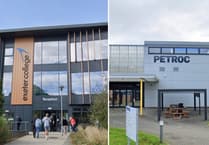
Over the last few years, the college has made a concerted effort to reduce its energy bills. Drastic savings have been made by combining a sophisticated energy management system with an in-school campaign to turn off unused lights and equipment, along with savings made from the school's solar panels, a wind turbine on Ball Hill, the new boiler and green energy incentives. The school has now reduced its energy bill from £100,000 annually to zero.
Community energy manager Keith Webber said: 'The UK relies on vast amounts of imported gas for its energy use. To not be reliant on such expensive sources of energy in the future — this sort of system is a solution to that.
'We have saved around £50,000 a year through our energy management system and reducing our energy consumption. That is a big part of reducing our bill down to nothing, and being mindful of energy use is something people can do at home.'
The college's energy achievements have garnered widespread recognition. Having already won the prestigious Ashden Award, it is now listed in Sustainia 100, an international publication showcasing what are considered to be the world's leading sustainability projects.
In January the college won the European prize in the Global High School category of the prestigious Zayed Future Energy Prize, which recognises and rewards innovation, impact, leadership and long term vision in renewable energy and sustainability. The awards ceremony saw principal Daryll Chapman and student Bryony Franco visit Abu Dhabi, joined by more than 100 world leaders.
Douglas Mullins, a Year 13 student and member of the college's energy team, said: 'Renewable energy needs to be promoted more, and an issue that is in the public eye.
'The implications of prolonged fossil fuel usage are dangerous, and we need to encourage more people to be environmentally-friendly.'
The environmental projects are not only reducing the college's carbon footprint and energy bills, but being used to teach students about the importance of renewable energy.
Martin Allen, a Year 13 student and member of the college's energy team, said: 'My interest in environmentally-friendly energy came from the college, and it grew from there. Having these sorts of projects at your school helps you to care about something.'
Despite their incredible achievements, the college is ploughing on with further energy saving schemes, including the installation of a second wind turbine on Ball Hill.
It also plans to work with the four primary schools in the Dartmoor Federation and other schools in the area to help them lower energy bills and carbon emissions.
Mr Webber said: 'A lot of the small schools use oil or electricity to heat their schools. We have saved a great deal but we used gas, which is cheaper than oil and electricity, so the potential for savings in those schools is even greater.'
An exhibition created by staff and students of the college detailing their work with renewable energy is due to take place at the Museum of Dartmoor Life in the spring. Details will appear in the Times in the coming months.
Comments
This article has no comments yet. Be the first to leave a comment.