

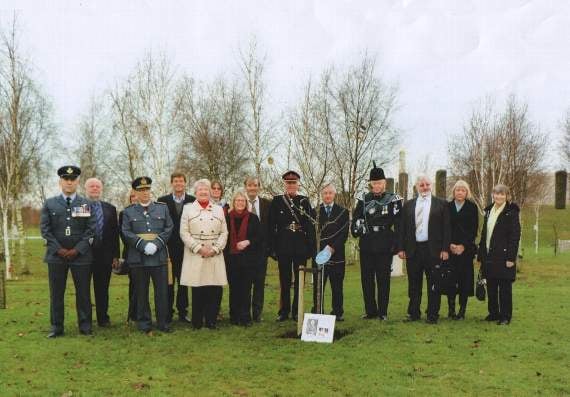
A BRAMLEY apple sapling from West Devon was planted at the National Memorial Arboretum in Staffordshire recently as a tribute to an unsung hero of the Second World War.
Flying Officer Michael Suckling’s photographs led to the sinking of the battleship Bismarck, the most feared ship in the German fleet. A Bramley apple tree from Endsleigh Nurseries was planted in his memory at the arboretum, as he was the great grandson of nurseryman Henry Merryweather, who was the first person to cultivate Bramley apple trees.
The tribute was organised by West Devon resident Celia Steven, FO Suckling’s second cousin and great granddaughter of the Bramley apple founder, along with the help of other family members.
Mrs Steven organised the memorial after raising £665 at a National Apple Day dinner at the Drake Manor Inn in Buckland Monachorum two years ago.


.jpeg?width=209&height=140&crop=209:145,smart&quality=75)
Mrs Steven said: ‘I never knew Michael Suckling but he was part of our family and I knew his mother and sister well. It was an honour to plant a Bramley as a tribute to his bravery — like so many more, he gave his yesterday for our today. This living memorial would have been part of his heritage. The National Apple Day dinner at the Drake Manor also enabled us to give a donation to the National Memorial Arboretum — such an amazing place and well worth a visit.’
Mrs Steven said that, apart from his family, not many people knew about FO Suckling’s part in the Bismarck’s destruction.
The ship was Hitler’s pride and joy and the most feared in the German fleet. It worried the British because it was felt if it could reach the Atlantic Ocean it would be a major threat to the shipping convoys that brought vital supplies to Britain. Spies watched as it was tested in the Baltic, out of range of allied war planes, but on May 19, 1941, it disappeared.
The admiralty were desperate to find it before it could escape into the Atlantic and FO Suckling was sent out in a naval reconnaissance Spitfire on the morning of May 21. He left his RAF base at Wick in the far north of Scotland with orders to search a section of the coast of Norway. He searched the designated area without luck and so decided to check the coast further north. His hunch paid off and he found the Bismarck hiding in a fjord near Bergen.
He circled overhead long enough to capture photographs of the ship and its escorts before returning to base. The admiralty wanted the photographs to be delivered to London immediately so he volunteered to refuel his Spitfire and deliver them.
By the time he reached the Midlands it was dark and, as he was running out of fuel, he decided to land his plane near his home. He ran to the home of a friend who had access to a car and they drove to London, arriving near dawn. Shortly afterwards a naval operation involving British warships got underway that ended with the sinking of the Bismarck on May 27.
Winston Churchill ordered that FO Suckling’s pictures be published under the title ‘The pictures that sank the Bismarck’.
FO Suckling was given a few days of home leave for his 21st birthday and on his return was sent out to search the coast of occupied France for two German warships. His plane was reported missing on July 21 and his body was never found.
Comments
This article has no comments yet. Be the first to leave a comment.