
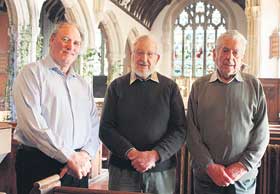
A?MOMENTOUS event 150 years ago in a small West Devon village is to be commemorated next week.
On January 21, 1865, at Kelly Church, Kelly, a dedicated group of bell ringers completed a peal — the name given to a type of performance of change ringing — the first ever peal to have been performed in Devon and Cornwall.
Change ringing is the art of ringing a set of bells in a series of mathematical patterns called 'changes'.
The group of members were of the Kelly Society of Change Ringers, which included the Rev Maitland Kelly, a pioneer of change ringing in Devon.


Next week, on Wednesday (January 21), Kelly Church will play host to the special anniversary, where six men will complete the peal of 5,040 changes of grandsire doubles, all from memory, taking almost three hours, non-stop.
The church is situated next to Kelly Manor House, which has been home to the Kelly family for more than 900 years. It was Maitland Kelly (1842-1929) who brought the art of bell ringing to the village from when he was a student at Oxford.
It proved a success and when he inherited the estate and moved to Kelly in 1899, due to the untimely death of his brother and father, he kept the bell ringing hobby alive in the village — Maitland even employed a coachman named Mr Boucher, not due to the man knowing how to drive a horsedrawn coach, but because he knew how to bell ring.
Maitland even managed to spread the art across the county.
Geoff Hill, master elect of the Guild of Devonshire Ringers, who is one of six people completing the peal on Wednesday, said: 'Maitland Kelly was a pioneer and put the village on the map for scientific change ringing.'
From an early age Maitland had an interest in ringing and was encouraged by Harry Trelawny of Calstock, who had raised a changing band among his estate and tenants.
When Maitland took over the Kelly Estate he made sure he did the same as Mr Trelawny and that his workmen and tenants learned scientific bell ringing.
Maitland was president of the Guild of Devonshire Ringers for 28 years until he died in 1929 and was a member of the Ancient Society of College Youths — the oldest ringing organisation in the country.
After his death Maitland's family continued on with his passion and nearly all of his family and descendants have been bell ringers.
Maitland's great grandson Warin Kelly, of Kelly House, a bell ringer and churchwarden of Kelly Church, confessed he was not confident in his 'math abilities' to be able?to be part of the peal, but said all are proud of the village's history and look forward to the commemoration.
'We are proud of the history. Maitland was 23 at the time of the peal — he was Devon's pioneer.
'The art of bell ringing is to control the bells and not let them control you.'
As part of the Kelly family's tradition, Warin took up bell ringing and even learned on the same bell his great grandfather Maitland once made his own.
'I did find it strange at the beginning as I started on a bell that he [Maitland] rang. It was a strange feeling that great grandad was ringing this bell and knowing that nothing has changed since he rang it.'
It is uncertain to know what exact peal was played in 1865, but it is known, thanks to a plaque at the church, that the Victorian men played three six-scores of grandsire doubles — being the greatest number of changes in the scientific of halfpull system ever rung in Devonshire.
Geoff added: 'There is no documented evidence that they rang what we will be ringing but we are ringing to commemorate the 150 years since as it was a tremendous achievement.'
The ringers on Wednesday will be: Geoff, John Steer, Ian VJ Smith, Fergus MS?Stracey (conductor), George E?Mudge and Donald Roberts. Donald, 83, was part of a peal rung at Kingskerswell 50 years ago, which commemorated the Kelly Peal 100 years earlier.
Geoff said: 'It's nice to know that this village has a tradition of Devon ringing. Maitland even encouraged scientific bell ringing in varied places to teach them about bell ringing.
'The history associated with Kelly Tower and bells is second to none. There is something about Kelly that has drawn people there.'
l The church was built in 1252. It was rebuilt in 1835 after being struck by lightning.
The church stands 60ft high and is built of granite.
The six bells at Kelly were cast by the Penningtons of Stoke Climsland, who cast countless bells in the Cornish village, although for Kelly Church they actually made the bells in Kelly in 1772.
The ring of bells was rehung in a new bell frame by Mr Hooper of Woodbury in 1867 and it is in this bell frame where they still stay.
The inscription on the tenor bell is Arthur Kelly, squire of the manor and the estate, and was Maitland's grandfather.
The family has lived in Kelly since the 12th century. Sir William de Kelly began to build the church in 1252. Many family members are buried there and the family has remained closely connected with it.
By 1742, Arthur Kelly was prosperous enough to replace part of the old pre-Tudor house by the elegant early Georgian building with its graceful staircase which you can see today.
Through the 19th century, the family continued to live the lives of prosperous country squires, devoted to their estate and with a close relationship to the people who lived in the hamlet and farms on it.
Even the existing lockup demonstrates the traditional gentry role of maintaining local law and order as Justices of the Peace.
Today, like many other country houses, Kelly House sold some of its estate, as maintenance had become a constant drain on resources.
The family is determined that in the 21st century new and imaginitive ways of facing the challenge can be found in order to continue to serve the local community.
For more information on Kelly House visit http://www.kelly-house.co.uk">www.kelly-house.co.uk
Comments
This article has no comments yet. Be the first to leave a comment.