
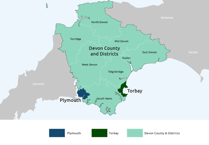
THEY may have cause to celebrate but it is business as normal for the dedicated Environmental Services Unit at West Devon Borough Council.
Fresh from winning a coveted Charter Mark Award for their excellence and high quality in public services the team are hard at work serving the community as usual.
Although most of us rarely come into contact with them, the officers' duties are wide-ranging and affect many aspects of our environmental health.
The unit — divided into Building Services and Environmental Health — covers things as diverse as pest control, food safety and pollution to control of building regulations and flood alleviation schemes.


David Banks as environmental health officer heads up a team of five environmental health officers, one scientific officer, a technical assistant, one pest control officer, a part-time dog warden plus some administrative support staff. On the building control side there is one manager and four control officers.
David says the team have to handle often difficult situations with tact and diplomacy. 'We see ourselves as educators rather than enforcers,' he says.
Quite often there are conflicts between people who have come to live in the country as they imagine it to be only to end up complaining about traditional countryside activities because they forget agriculture is an industry.'
Noise nuisance can be anything from a dog barking to factory machinery but it is not as simple as reporting a one-off offending sound.
'It is not about the noise — but the number of times it happens,' says David.
'Take a lawnmower: a man may cut his lawn for 20 minutes once a week. But if he cuts it for 20 minutes five times a day that is a nusiance because it is unreasonable activity.'
The council has wide-ranging powers to curb noise nuisance such as a court prosecution which can lead to heavy fines and the seizure of equipment.
The unit responds to complaints and calls for help from the public — but it also does a lot of pro-active work helping people comply with regulations.
'People are looking for guidance and say the way we do things are refreshing because we try to assist them in complying with statutory government legislation,' says David.
'You have to identify the risk and put in a control mechanism to stop it — and then put in a monitoring system to make sure the control mechanism works.'
Ironically, in our hygiene-conscious age, the incidence of food poisoning has never been so high.
David says it is partly to do with the change in our eating habits and the fact people know their rights, know there is an environmental health office and know they can complain.
GPs are obliged to report any food poisoning cases and the environmental health office is obliged to investigate — this also helps underline the size of the problem.
'We try to track the problem down to likely sources — who else was ill, who had the same food . . .' said David.
These days the experts can trace the cause of food poisoning as expertly as detectives. Quite often it is easily possible to establish likely sources of food poisoning. Illnesses have different incubation times.
'There are different species of salmonella — some of which are closely associated with specific food types,' says David.
'If you have been licking out the cake mix bowl as sure as eggs are eggs you will have enteritidis salmonella — which you only get from eggs!'
The fact some people escape illness while others succumb is often down to the vulnerability of the potential sufferer. The young and elderly are the most susceptible.
Sometimes regular exposure to a substance can build up an immunity. David cites an interesting situation where some incomers to an establishment became ill while those who had dwelled there for some time were fine.
'At first we thought it was food poisoning but that didn't add up. Then we sampled the water.
'Some plumber had accidentally connected up part of the premises to a raw water pipe — so they were drinking river water! The people who had been consuming it for some time were not ill but those that had just arrived were.'
The unit is constantly monitoring water quality in the borough — both in the private and public sector.
David said they liaised with the water company and sample private water suppliers in West Devon — of which there are 2,500.
'A total of 18 per cent of the population get their water from private supplies which is one of the highest in the country.'
One of the biggest private water suppliers like the Ambrosia factory at Lifton is sampled once a month while a moorland pub would be sampled four times a year. The volume of water used is the criterion for the number of visits made.
'People don't realise the wide range of work we are involved in. Environmental Services cover so many aspects — that is why it is so pleasing to get the Charter Mark Award.
'It is good for the team — and for the public as it shows the high standard of commitment the community receives,' said David.
l See news story — page 13.