

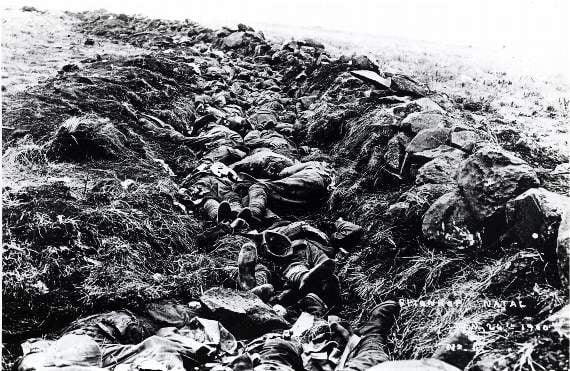
THE tales of ordinary British soldiers who served in the Boer War in South Africa at the turn of the last century and the effects on their families, have been recounted in a fascinating book by a Tavistock author.
‘Tracing Your Boer War Ancestors — Soldiers Of A Forgotten War’ by Jane Marchese Robinson, brings together a collection of stories of those men, many from impoverished back-grounds, who served their country and, for many, paid the ultimate price.
The war took place between 1899 and 1902 and some 180,000 Britons, mainly volunteers, travelled 6,000 miles to fight and die in boiling conditions on the veld and atop ‘kopjes’ (hills) to fight the Boer (white South Africans of Dutch descent), who wanted to maintain their independent republics from the British Empire. More than 20,000 British troops died, more than half suffered enteric, an illness brought about by insanitary water.
For Jane, aged 64, who is now retired after working for more than 30 years as an advocate for marginalised groups, including the homeless, people with disabilities and mental health problems and asylum seekers, it is her first book and one which took considerable research, including a visit to the war’s battlefields in South Africa.




She was inspired to write a book after completing a MA in creative arts at the University of Plymouth and approached her now publishers (Pen and Sword).
Research into her maternal grandmother, who had come to this country from Belgium as a refugee at the outbreak of the First World War, led her to the London Metropolitan Archives. While there she became interested in another story of a workhouse family whose father had served in the Boer War, which gave her an idea for a fictional story. She approached the publishers, but much to Jane’s surprise, a commissioning editor asked if she would be interested in researching a book on the Boer War, about the ordinary soldier and of soldiers’ families ‘as nobody had done so before.’
Jane said: ‘I was totally surprised but happy to write on the subject, although my knowledge on the Boer War was virtually zero. I love delving, and getting into the bottom of a subject and working through the archives. Nowadays it is amazing how much you can research and find on the internet, and especially in the National Archives.
‘I also wrote to a number of newspapers throughout the country asking them for people to contact me with their stories of their grandfathers who served in that war. I had a lot of photos and diaries sent to me, which is quite a privilege. Because there are not that many publications on the Boer War it was as if there were people out there waiting for someone to call them.’
One of the stories is of farm worker Moses Mann from Holne on Dartmoor, who in a time of economic depression for the agricultural industry, joined the Army, aged 25, and served in the Second Battalion of the Devonshire Regiment. In 1899, at a ceremony in Totnes, he married Louisa Barnett, a servant from Bannerwell Street in Tavistock, whose father was a miner. A few months later Moses was despatched to South Africa but died shortly after the Battle of Colenso in December of that year — leaving Louisa a widow, barely a few months after their marriage.
A more peaceful ending came to John Meardon from Hatherleigh. After working on a farm since the age of nine, he enlisted in the Royal Engineers, and saw service in India. John was involved in fierce fighting to relieve the besieged town of Ladysmith and rose to the rank of sergeant major. He served for 33 years before retiring in his home town and working as the local postman.
Jane’s book is littered with such moving stories of individual, ordinary men, who led extraordinarily tough and short lives.
One such soldier was George Ravenhill, a native of Birmingham, who served with the Welsh Fusiliers and was married with a daughter when the war started. He was the only private to win the Victoria Cross at Colenso, after risking his life and being wounded in helping to retrieve vital artillery.
As Jane wrote: ‘That VC was later taken away from him as the result of being prosecuted for theft. By that time he had three children and was so penurious that they all ended up in the workhouse.’
Now the prolific writer is aiming to publish her novel on the Boer War, There is a Green Hill (or Groen Kop), which is based on the battle in the war.
‘In my view the war was basically about the British pursuing the possession of the gold in the Transvaal and because of it many young men from Britain and the Commonwealth were sent to die in appalling circumstances. It was not Britain’s finest hour, attacking the Boers, burning their farms, polluting their water, and rounding up their women and children and putting them into concentration camps. It was certainly a dirty war conducted by both sides.’
Comments
This article has no comments yet. Be the first to leave a comment.