

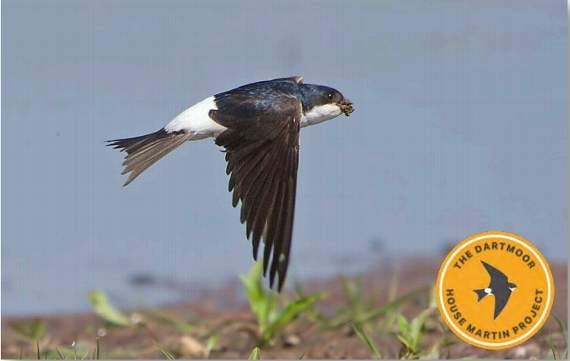
DARTMOOR walkers are being asked to count any house martins and nests they see as part of a project charting the birds.
The birds fly in from Africa as summer starts and build beautifully constructed nests high under eaves on the sides of buildings using over 1,000 pieces of mud for each one. They then get busy hoovering insects from the sky to feed their hungry chicks.
But house martins are in decline nationwide and it’s not clear exactly why. In the last 30 years, they have disappeared from half the places they used to be found in Devon.
The Dartmoor House Martin Project was set up last year by Devon Birds, Dartmoor National Park Authority and the Duchy of Cornwall to research how they are doing on Dartmoor.




Those running the project are asking for the public’s help to find out how many house martins are nesting within the national park. Three meetings are planned in Princetown Visitor Centre today (July 6) at 7.30pm, Yelverton Memorial Hall on July 13 at 8pm and Ashburton Town Hall on July 14 at 7.30pm to get people involved.
At each event, renowned ecologist and artist John Walters will give an illustrated talk on the secret lives of house martins.
This will be followed by a discussion of the reasons for their decline and how they can be helped. Members of the public will be asked to record house martin nests they spot in their area and enter the information on the Dartmoor House Martin Project website.
There’s also the chance to win a house martin nest box worth £21.95 – ten are on offer at each meeting.
Kevin Cox, chair of Devon Birds said: ‘I love house martins and look forward to their return each year. They are such amazing acrobats, swooping over meadows, sweeping up insects, looking just like mini-orcas of the skies.
‘I know some people don’t like the mess from their nests but it’s easily dealt with by placing a board underneath - and surely it’s a small price to pay compared with the privilege of sharing our homes with these charming and increasingly rare birds.’
Last year, six parishes were surveyed from Buckfastleigh in the south to Chagford in the north and Mary Tavy in the west. Volunteers spotted over 300 nests in total and the website shows all the sightings, providing valuable information for scientists wanting to understand why the birds continue to breed in some areas but not others.
It is hoped that this year, the roll out of the project moor-wide will provide a broader picture – all that is needed is more volunteers to spend some time looking up and counting.
More information on the project can be found on the website www.dartmoorhousemartins.org
Comments
This article has no comments yet. Be the first to leave a comment.