
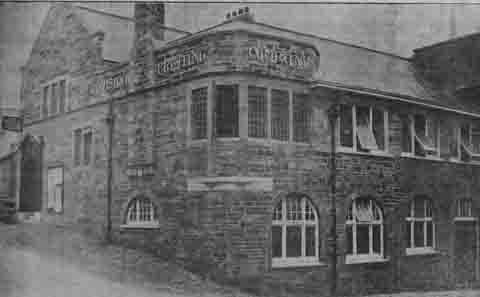
HIDDEN away, just off the main thoroughfare, in Pym Street, Tavistock, is the building that today houses Kingdon House Community Association.
You may know it well, belonging to the many groups that use it, or you may have just wandered past a few times. But either way, you might have wondered about its origins or even cursed at the way it juts out beyond the building line as you tried to park.
Originally built by the Duke of Bedford for the Tavistock Gazette and Printing Company, the trustees of the association have always known that it is an important example of a building in the arts and crafts tradition established by William Morris, and extensively used in country houses of the 1890s onwards.
More recently, thanks to the painstaking research of one of the trustees, Brian Fyfield-Shayler, we have come to understand just how rare it was for commercial and industrial premises such as ours to be designed in this style.




The building that became Kingdon House was started in 1906 and was specifically designed to accommodate huge new machine printing presses on the ground floor. This explains why it projects out beyond the building line in what became Pym Street, and why there is such a wide works entrance in North Street — formerly a narrow alley called Love Lane. There is a much grander front entrance in Pym Street giving access to the newspaper offices above.
Contemporary reports show initial spirited opposition to the plans from the local councillors, but small compromises and inducements were made by the Bedford Estate Office and in the end, of course, the designs were approved.
Architect, Arthur Southcombe Parker, about whom not much was formerly known, is now emerging as the man responsible for designing what turned out to be the Duke of Bedford's last major project in the town, started in 1890 when what is now Drake Road was cut through from the north side of Bedford Square up the hill to the recently opened railway.
Southcombe Parker was the architect for virtually all the magnificent buildings which stand in this area today.
First the Constitutional Club and the corner block which now contains HSBC, 1895-6. Then, next up the hill offices for the town council, completed 1899.
Ambitious designs for the opposite corner, a superb block which now includes TSB, Lloyds apartments and Elford Fine Arts, stretching up the west side of Drake Road, finally completed in 1909, could not proceed until alternative premises were found for the Tavistock Gazette and Printing Company, which for many years had occupied an old building at number 4 Bedford Square. The building that became Kingdon House was therefore a key element in the overall plan for this new area.
Seventy years later, in 1976, by which time the printing presses had fallen silent and been moved out, the building's new life as a centre for the arts and community use began. Over the years it has accommodated a huge range of groups, too numerous and varied to list here. They include Citizens' Advice Bureau, a vegetarian café, a community transport scheme, a west-country housing association, a job centre, martial arts groups, music, drama, ballet and dance classes, alcohol and drug agencies, counselling and therapeutic services. Many of these continue today. It has also very recently hosted a superb exhibition by Tavistock Peace Action Group on war and peace since World War One.
However, there is a problem — after a hundred years the beautiful Hurdwick stone has become porous and no longer keeps out the weather. The fabric of the building needs a lot of attention. Inside it urgently needs to re-configure the space to meet the requirements of its users, including much better disabled access and facilities.
Present architect Stephen Whettem, designer of Tavistock's hugely successful Wharf conversion, has drawn up stunning plans for Kingdon House, sensitive to the original concept and fully compliant with the Grade II listing, to be implemented in two stages — to stabilise the external structure, and to upgrade the interior — as and when funding becomes available.
Kingdon House owes its origins to the munificence of the Duchy of Bedford and the vision of Arthur Southcombe Parker at the end of the 19th century.
Its transformation in the 1970s into a centre for the arts and community was made possible by two wonderful patrons, Norna Beadle and Helen Rowett, and plans are underway to celebrate the centenary of the birth of these ladies with a special exhibition in 2015.
If you have interesting stories and information about Kingdon House (nee Tavistock Printing Works) Brian and the rest of the trustees would love to hear them.
Comments
This article has no comments yet. Be the first to leave a comment.