
ONE of Tavistock's most iconic trees has been given a new lease of life.
The large weeping beech that dominates the western (town) end of the disused Victorian cemetery in Dolvin Road, dates from 1860-70 and is one of the largest of its kind outside Kew.
Severely damaged in the storms of 1987, which destroyed thousands of trees across the South West, it was subsequently skilfully braced.
Then, shortly after 2pm on Sunday, October 1, 2006, disaster struck again.
Extraordinarily strong winds, unusually early in the season while the trees were still in full leaf, suddenly changed direction and brought down nearly half of the priceless tree, including the braced section.
The crack as it snapped was heard like a gunshot by residents on Kilworthy Hill, on the opposite side of the valley.
I was phoned by the late Bill Collacott, whose widow Vera still lives next door to the cemetery, just 30 yards from the tree. As the then co-ordinator of the Tavistock Tree Group, I hurried down to inspect the damage and take photographs.
A number of nearby headstones were destroyed by the falling section of trunk and huge branches.
It took a lot of time and effort by the town's works department to clear the debris, but nothing could be done for the tree itself, except tidy the jagged wound.
But nature has a great way of healing itself and over the following years the weeping beech, though remaining badly scarred, has largely re-balanced itself.
However, at about 150 years old, it is now entering the final phase of average lifespan for a tree of this type.
It may survive another 50 years and with luck, to the end of this century, but is not likely to survive into the next.
Four years ago, the tree group arranged for expert Michael Turner of Endsleigh Gardens Nursery at Milton Abbot to take a number of grafts from the ageing tree — an operation that required great professional skill and experience.
Through the last four winters the grafts have been nurtured under plastic at Endsleigh Gardens.
In January, 2015, Michael Turner's successor, Adrian Steele, delivered the long-awaited good news — the young trees, four in number, each up to five feet tall, were now ready for planting.
The best specimen was planted at the end of Dolvin Road Cemetery under the watchful eye of Tavistock Town Council's works superintendent Ken Sedgmen and his staff.
The second tree was planted in Plymouth Road Cemetery, in the new section towards the rear.
The remaining specimens have been accepted by the Very Rev Christopher Hardwick of St Eustachius' Church, Tavistock and by the Rev Sean Brassil, vicar of St Andrew's, Whitchurch.
Their respective churchwardens are making arrangements with the council's works department regarding the exact location for each tree and it is expected the plantings will take place very soon.
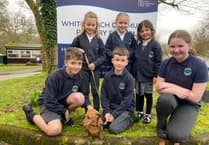
It is hoped local children will take part in the events, as they are the new generation that will grow up with and care for these trees through the rest of the century.
The weeping beech, fagus sylvatica pendula, traditionally associated with mourning, was a favourite choice of our Victorian ancestors for planting in burial grounds.
The four trees will link the last resting places of the majority of the town's residents over the last thousand years.
A graft, as distinct from a seedling —which is, as it were, a child of the parent tree — is part of the original tree, a cutting, virtually the same tree transferred to a new place.
The tree planted in Dolvin Road in the 1860s was itself a graft, taken from an older weeping beech, possibly one that still stands in the grounds of the Duke of Bedford's lodge at Endsleigh.
The Duke was very fond of his trees and encouraged his nurserymen to cultivate new and unusual varieties, which is why the area around Tavistock has a high concentration of copper beeches, also cultivated by grafting.
It is possible that it was the same unknown nurseryman in the Duke's employ who grafted not only the magnificent copper beech that stands near St Eustachius' porch, but also the weeping beech in Dolvin Road which appears to be about the same age.
Both have the marks where they were grafted still clearly visible.
Each nurseryman developed his own individual style of grafting, a personal signature which could be recognized by a fellow expert — in the same way a top surgeon's work can be identified by another.
It is fitting that these two trees will now stand together, beside the church at the heart of Tavistock.
l Brian Fyfield-Shayler remains an honorary life member of Tavistock Tree Group, following his retirement as its co-ordinator in 2012.
Comments
This article has no comments yet. Be the first to leave a comment.