
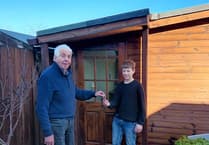
A RETIRED senior police officer living in Okehampton was finally able to close the door on his only unsolved murder case last week —23 years after the crime was committed.
John Domaille led the police hunt for the killer of 38-year-old Mary Gregson when he was a detective chief superintendent in the West Yorkshire Police.
Mrs Gregson had been killed as she walked to work along the Leeds-Liverpool canal towpath in August 1977. She was beaten, sexually assaulted and strangled, and her body dumped in the canal.
Mr Domaille, 66, said: 'I remember it as being a very sad case — Mrs Gregson had a young son. I was disappointed that after spending months on a thorough investigation we could not find out who did it.

'There was a building site near to where the body was found and we thought that might be where the killer came from. But canal banks are notorious for attracting all sorts of strange people.
'We interviewed 9,000 people and did not produce a result.'
But the case was re-opened last year when advances in DNA technology meant a genetic profile of the killer could be compiled — and the retired police officer was contacted at his Okehampton home and asked to help the investigation.
It resulted in a judge at Sheffield Crown Court last Friday sentencing 47-year-old Ian Lowther to life imprisonment for the murder.
The court heard that Lowther, who was 24 at the time of the attack, had been interviewed by police shortly afterwards but was able to convince officers he had not been responsible.
Attempts to carry out scientific tests on a semen stain on Mrs Gregson's clothing in 1977, 1988 and 1995 had proved unsuccessful.
Mr Domaille said he remembered they interviewed Lowther but he was 'alibied out' after several friends said they had been drinking in a pub with him.
Mr Domaille said: 'I remember the enquiries into Lowther's movements were done very thoroughly and the investigating team eliminated him from the enquiries. I am sure they would have reached the same conclusion today, there are difficulties in people being precise about times.
'But there have been tremendous technological advances in DNA. It is of great assistance to investigators as it lifts the weight of evidential pressure from the police — it is either there or it isn't.'
The detective superintendent leading the latest investigation — a sergeant in the murder room when Mr Domaille led the hunt — telephoned him earlier this year to seek his advice.
'I told him there was a top line of suspects and then a second degree of suspects which included those from the building site — and that's where Lowther was.'
Lowther was the 532nd man to be seen this year and agreed to provide a mouth swab for a DNA test. He later confessed to the crime.
The judge described the attack as 'a wicked and brutal murder'.
Mr Domaille said he was 'absolutely delighted' that the crime had been solved.
'When a crime is undetected you cannot get it out of your mind — you keep thinking, have I missed something? But there was no fault in this investigation. This conviction means all that hard work was worthwhile.'
The life sentence means Mr Domaille can finally 'close the file' on the only unsolved murder of the 60 he investigated — two previously unsolved murders were later found to have been committed by Peter Sutcliffe, the Yorkshire Ripper.
Mr Domaille started his police career as a constable on the beat in Exeter in 1954. He rose through the ranks to become assistant chief constable of West Yorkshire. He retired from the force in 1986 and opened Lyndridge Residential Home in Okehampton, now run by his daughter, Carol Barkwill.
Mr Domaille, who is chairman of Okehampton College governors and of Okehampton Argyle Football Club, lives in Hatherleigh Road, with his wife, Maureen.