
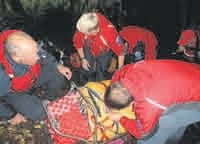
THE first mountain rescue team to be formed on Dartmoor was in Tavistock in 1968. More than 40 years later, it helps to provide an effective search and rescue facility for Dartmoor and the surrounding area. Dartmoor Search and Rescue Team is one of four volunteer teams that make up the Dartmoor Rescue Group and is a member of Mountain Rescue England and Wales. In addition to Tavistock and Okehampton, there are groups based in Plymouth and Ashburton. The teams work in all extremes of the moor's sometimes notorious weather, in all seasons, 365 days a year. Around 40 highly trained members spend around 18 months training to be part of the Tavistock DSRT branch. All are volunteers and are part of the team for the love and passion of helping their fellow community members if they become distressed and lost on the vast moor. Over recent years the group has assisted the police, not just on Dartmoor, but around towns and farms, helping locate vulnerable people. But now the team is appealing for people to come forward if they feel they could prove to be an asset to the group, from hill party members, to committee support staff including fundraisers and controllers' assistants — all being trained by the team to a high standard. It costs around £17,000 a year to fund the Tavistock team which is money raised by the group and donations. But if any extra equipment is needed or has to be fixed then the group has to find these extra funds — and with stretchers alone costing £5,000 each, the team relies heavily on fundraising. Within the team there are people with different specialities — casualty carers, who undergo an intense first aid and trauma course, doctors, a water team highly trained to deal with 'swift' water ie rivers, a hasty (running) team for quick searches, dog handlers, team leaders who deal with search management, and a rope team trained to rescue people from steep ground. In a live callout the police notify the team leader of the situation, who then alert the team via a text message giving the situation and a grid reference. Members then reply saying how quickly they will be able to attend, or if they cannot attend. Understanding the mind-set of people reported missing is also another talent of the team leaders, who are sent on a week long training course for this purpose alone. When a report comes in, for example, of a person with dementia who has gone missing, the team leader has been trained to know that people with dementia will generally not stray further than 500 yards from their home and tend to walk along direct paths. The team leader could then prioritise a local search with its running and dog team to start looking within the area first before they start looking further afield. Along with the highly trained team members are the search dogs. In Tavistock there are five handlers and their dogs, who are 'air scent' trained. Kat Holden, fundraising officer for the team, said: 'The handlers train their own dogs in their own time as well as being a team member. 'The dogs are a huge asset to the team and they are trained to smell air for any human.' Other committee posts also include a secretary, volunteers in charge of finances, equipment and vehicles, and fundraisers. If you want to be a part of the team, the process involves filling out an application form expressing your passion for Dartmoor, which can be found on DSRT's website. Then there will be an introductory walk on Dartmoor, where members will see what your navigation skills are like, and how people react, and prepare themselves for the unpredictable weather. Kat said: 'If we then feel you have potential then we would invite you to be part of the team, and have a six week probation.' A log book of demonstrated skills also needs to be completed, so the team can see you can complete certain tasks to a high level — including navigational skills, first aid, dealing with helicopters, and radio communication. 'Once that is all signed off you will then have a navigation assessment which is a six hour night navigation exercise, which, if you complete, you are then asked to go on a call out list. 'It usually takes people one year to 18 months before they go on a call-out list. 'It may seem daunting at the beginning but you are well supported and you get teaching along the way. 'All the training is done so that if you are out at 4am in the morning, when it is freezing cold and pouring down with rain, you are safe in the extreme conditions of Dartmoor', said Kat. However, if you are not a keen walker and would prefer to help in other ways, fundraisers are always welcomed, helping organise events from town collections, pub quizzes, or undertaking sponsored events in aid of the Tavistock DSRT. Kat said: 'For 40 members to raise the money it takes a lot of extra time. Help in anyway would be great and if anyone can think of any other fundraising events, please let us know. 'We all love Dartmoor and being out in it, even in all extremes of the weather. It is our way of getting to know Dartmoor better and be involved in the community, and to help people in need.' Over the next few months the team can be seen at the Lydford Gorge Emergency Services day, in Tavistock town centre on May 31 doing a street collection and at the carnival in July. Based in Okehampton, the North Dartmoor Search and Rescue Team has been ideally located to deal with incidents within the wilder and higher parts of the moor, since 1968. The North team is also a member of PENMACRA, the South West region of Mountain and Cave Rescue England and Wales. As a 999 service, the Okehampton team, like its counterpart in Tavistock, is deployed by Devon and Cornwall Police. And not only for incidents on the moor — it has a mobile capability which allows the members to be deployed to a wide area covering Devon, Cornwall and Somerset. On occasions members have been requested to help with incidents in other parts the country. On average the NDSRT attend 20 incidents each year and these range from missing and injured persons to despondent and suicidal people, and dementia sufferers. As well as rescue duties the team gets involved with local community events including carnivals, fun runs and moorland challenges. Each year it help to provide safety cover for the Ten Tors Expedition, which is managed by the Army and involves Royal Navy and RAF units as well as the police and the Red Cross. During the last four years the team has added swift water rescue to its capability, and many members are now fully trained technicians. The NDSART has been busy fundraising for two years to upgrade their facilities and move into a new, purpose-built centre that is more fit for purpose. Having reached an initial £100,000 fundraising target to purchase their new building, the charity is now in the process of raising further funds to make their new rescue centre fit for purpose. This is estimated at a further £75,000, on top of the £15,000 required for the day-to-day running of the team. The team currently has 35 members on the call-out list, plus six training members. Both full members and trainees train once a week after work on Tuesdays. Most of the members have full-time employment and have to balance work and family commitments along with their commitment with the team, making sure they are available 24/7, 365 days of the year. Paul Vachon, search manager, said: 'It always amazes me how volunteers, from all walks of life, come together and work as a cohesive, dedicated and professional rescue organisation. 'There are many people alive today who owe their lives to such rescue teams.' Incidents are controlled by search managers — the team currently has four. A search plan, in consultation with a police controller, is put into operation using SARMAN, a specialist search management computer programme, and missing person behaviour profile. Teams are then deployed to areas prioritised by the plan, to search for the missing or injured person. When found, casualty care trained members take over and administer any medical care needed before the casualty is evacuated to safety. One of the team's proudest moments was when many members received the Queen's Jubilee medal in 2012. For further information on the DSRT, to find out how to join, or to volunteer to help with fundraising visit http://www.dsrt-tavistock.org.uk">www.dsrt-tavistock.org.uk



Comments
This article has no comments yet. Be the first to leave a comment.