

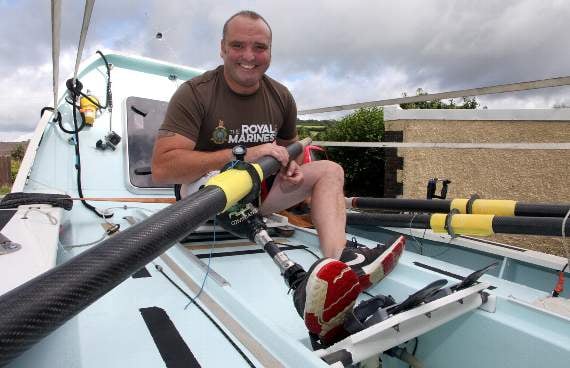
AMPUTEE and former Royal Marine Lee Spencer is preparing for his next challenge, and it‘s a big one — he’s planning to row solo across the Atlantic without a support boat, in the hope of securing two Guinness World Records.
Lee, 47, from Horrabridge, hit the headlines in early 2015 after he and three fellow amputee former and serving servicemen rowed 3,000 miles across the Atlantic. The men braved tropical storms, 40-foot waves and sleep deprivation to row from La Gomera in the Canary Islands to Antigua, in a record-breaking 46 days, six hours and 49 minutes. While 29 crews entered the race, they really stood out - as all the others were able-bodied.
They raised money for charities that help disabled service-people, including Prince Harry’s Endeavour Fund, and collected their medals from the Prince himself.
Now Lee is taking up his oars again to cross the Atlantic to row from Gibraltar to Venezuela. He sets off on January 18, as most people are taking down their Christmas decorations, with everything he needs - food, clothes and water - inside his specially designed boat. His wife Claire and children Billy, 20, and Harriet, 21, will be waving him off.




He is aiming to secure two further Guinness World Records, both the record for an amputee crossing the Atlantic and a second for the fastest rowing speed between two Continents - Europe and South America.
‘It is about 3,500 miles, so it is about 500 miles further than the last race we did,’ says Lee, who lost his left leg below the knee in a road accident on the M3 when he went to help a another motorist who had broken down. ‘I’m expecting it to be tough. I’m rowing for six hours on and one hour off, 24 hours a day so it is extremely arduous. I will lose 25 per cent of my body-weight.
He is training with daily weight training sessions and rowing on his rowing machine in daily sessions, ‘although there is no way to recreate what it will be like at sea,’ he says.
The former Royal Marine Colour Sergeant, who had survived tours of Iraq, Afghanistan and Northern Ireland unscathed, was hit by another car which ploughed into the back of him as he went to help a motorist who had broken down. ‘I saved my own life by tying a tourniquet around my leg, and I got a police commendation for my actions,’ he says. ‘I was in hospital for seven weeks. Then I was at Hasler at HMS Drake in Plymouth, the Royal Navy rehabilitation centre. I learned to walk again one step at a time.’
It was here that he met serving Light Dragoon, Lance Corporal Cayle Royce from Dartmouth, who underwent a double amputation and lost the fingers on his left hand following an IED blast in Helmand, Afghanistan. Cayle got him into rowing and became the skipper of that first transatlantic voyage Lee took part in.
‘Before I met Cayle, the sum extent of my nautical experience before this was crossing the Tamar on the Torpoint ferry,’ said Lee. ‘He had just finished rowing the Atlantic with Row for Recovery. It made me realise that there were still ways I could challenge myself and do amazing things, even though I was disabled.
‘I’m doing this latest row, again, to prove that there is life beyond disability, and that no one should be defined by their disability. It is about proving that disabled people have worth.’
Rowing without the full use of your legs is much more challenging, as it will be Lee’s torso and arms putting in the brunt of the effort. ‘Seventy per cent of the power comes from your legs, so it is much much harder for amputees,’ he says.
He expects to lose a lot of weight during the row, however much he eats and drinks, because the effort demands 8,000 calories a day.
‘I’m eating and drinking lots and rowing a lot and doing lots of weight training to bulk up as much as I can,’ he said. ‘I’ve put on a stone and I’ve got to put on another stone to be ready for the row.’
He’s just collected his boat, Peggy, from Essex and has started training properly for the voyage.
‘At the moment, putting it all together is really really difficult, it is the hardest thing I have ever done,’ he says. ‘I want to get as many local businesses as I can engaged with what I am doing.’
He is currently seeking sponsors for the voyage, which is expected to cost between £60,000 and £90,000, and has reached £23,000 in his target. The voyage will support a number of charities which help military amputees, including the Royal Marines Charity and the Endeavour Trust, which funded his first rowing adventure. It works to help disabled servicemen and women become active again.
‘When I lost my leg, I went from being an extremely active Royal Marine Commando, defined by what I could do physically, to being a disabled person,’ he says. ‘But rowing across the Atlantic made me realise that I’m the same person. I can’t underestimate how important that sense of identity is.’
Find out more at www.leespencer.co.uk — Lee will be Tweeting during his voyage at www.twitter.com/_leej spencer
Comments
This article has no comments yet. Be the first to leave a comment.