
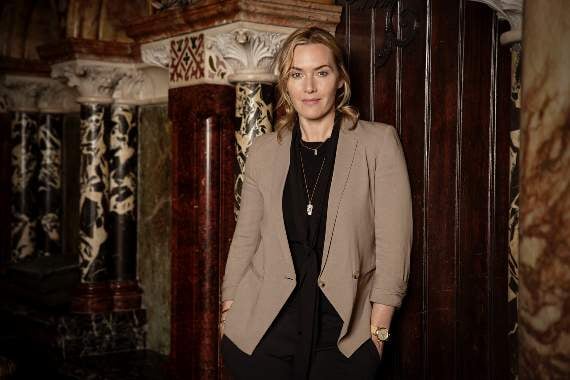
HOLLYWOOD starlet Kate Winslet will pay a visit to Dartmoor Prison in tonight’s episode of BBC One’s Who Do You Think You Are?
The Oscar winning actor will embark on her own very personal journey into her family history, looking into both her father’s and late mother’s ancestry.
The investigations into the history of her paternal family led her to visit the Princetown prison, where her great-great-great grandfather, William Colquhoun, held the position of principal warder. She visited the prison in May to film part of the programme.
In 1839, William, who had 11 children, was suffering from chronic rheumatism and so was discharged from the army after 30 years of service in the Grenadier Guards — a prestigious regiment responsible for guarding Buckingham Palace — and the 30th Foot regiment.



During the programme, a historian reveals William’s service record to Kate; he joined the Grenadier Guards as a drummer when he was just 11 years old.
William served in the regiment for almost 20 years, before transferring to the 30th Foot regiment, where he was promoted to drum major. Drum majors were performers in charge of leading the regiment during marches, tossing their canes into the air and commanding the parade.
Speaking about William, Kate said: ‘Well I hope he was good at his job because he had 11 children to support and a young wife — a lot of mouths to feed.’
In addition to their ceremonial role, drummers also played a darker role in the British Army. Their strong arms and good rhythm meant that they were also tasked with carrying out corporal punishment — specifically, using the infamous ‘cat o’ nine tails’ whip to flog the bare backs of those being disciplined for acts such as desertion, theft or drunkenness.
During the episode Kate is told that as a drummer, William would have had to carry out these punishments, and as a drum major he would’ve had to supervise them. They were public, theatrical occasions where the whole regiment would be gathered to witness the flogging. The historian going through William’s service record explains that there really wasn’t a choice for William — it was part of life in the army and didn’t make him a monster. It was flog or be flogged.
Upon leaving the army in his early 40s, William took up his position at Dartmoor Prison.
When Kate’s great-great-great grandfather was a warder at Dartmoor, the prison was going through a period of change. Arriving with trepidation at the imposing facility, Kate meets a historian who explains that in the mid-19th century Dartmoor was forging a new and relatively progressive approach towards prisoners — with a focus on rehabilitation rather than transportation and punishment.
Men were taught trades and there was an education programme that included subjects like history and geography.
A newspaper article from 1851 describes a tour of the prison, given by William, describing him as an ‘intelligent officer’ with ‘the strict disciplinary habits of an old military man’.
William died in Devon in 1856. Two of his children joined the army like their father, and his father before him. Before leaving Devon, Kate visited William’s grave in Plymouth, where he is buried in common ground with no headstone.
Kate’s journey into investigating her parental lineage began in Reading, where she was born and grew up. Her journey also leads her to delve deeper into her Scandinavian heritage on her mother’s side, leading her to the Halland parish in Sweden to find out more about her great-great grandfather Alfred, great-great-great grandfather Johan and great-great-great-great grandfather Anders.
Kate Winslet’s episode of Who Do You Think You Are? will air on Monday, August 12 on BBC One at 9pm.
Comments
This article has no comments yet. Be the first to leave a comment.