

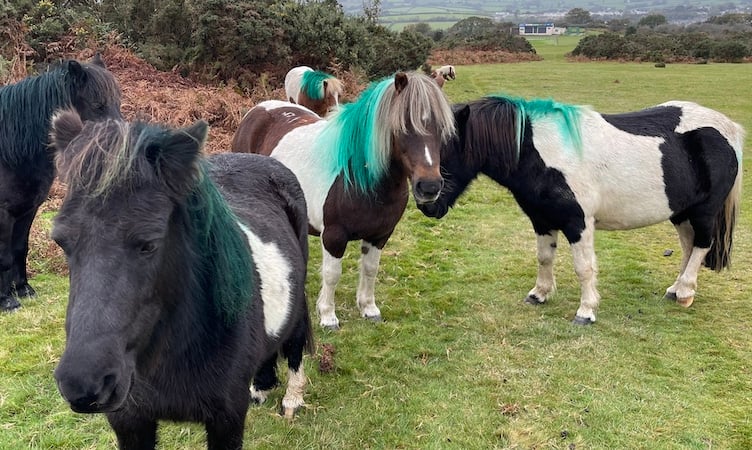
Anyone wondering why there are ponies out on Dartmoor this autumn sporting green streaks on their manes might be interested to know that it has nothing to do with Halloween.
They are in fact part of a mare contraceptive scheme run by the Dartmoor Hill Pony Association, who want to make sure that ponies born on the moor will be wanted and loved.
The green dye, used for the first time this year, will allow the mares to be easily located when due for their next shot of the contraceptive drug after 23 weeks (almost six months). This quick and painless operation is carried out by members of the Friends of the Dartmoor Hill Pony Association.
Charlotte Faulkner runs the Friends of the Dartmoor Hill Pony and its sister organisation the Dartmoor Hill Pony Association. She explained that the contraceptive scheme, which her organisation has been running for more than five years, was an alternative to taking stallions off the moor altogether.
-found-by-the-roadside.png?width=209&height=140&crop=209:145,smart&quality=75)



'We feel very strongly that semi-wild ponies should live in normal family groups with mares and stallions running freely, she said.
'The stallions stop the mares wandering too far and keep a herd leared to a particular area of the moor.
'We need livestock, including the ponies, eating on Dartmoor to preserve the ecology and help to stop certain plants taking over.
'It is not by accident that Dartmoor is such a wonderful, beautiful area full of rare flora and fauna because of the way the moor has been managed over the last 4,000 years by man using ponies, cattle and sheep to create the habitat of so many different plants animals and insects.
’The contraception scheme controls the number of foals born to these family groups, keeping numbers within the range that can be sold to good homes and reducing the need to cull.
’We managed to find virtually all the mares we needed to give a booster contraceptive to, despite not having people on the ground to tell us where they had seen the ponies we were looking for.
'This year we are looking at 99% efficacy of this project with the help of some green dye.’
She added that the mare contraception scheme had been well-received by hill farmers. ’It allows them to keep the herd’s number of foals to fit the market for selling them,’ she said.
Comments
This article has no comments yet. Be the first to leave a comment.