
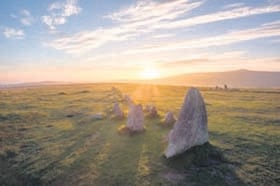
VISITORS to the Dartmoor National Park Visitor Centre, Princetown, can see a stunning new exhibition by photographers Adrian Oakes and Anna Curnow.
The exhibition contains images of Dartmoor's prehistoric heritage, including burials, stone circles, stone rows, settlements and standing stones.
These relics of our ancient ancestors can be found in such numbers on the moor that the national park is considered one of the most important areas in western Europe for prehistoric archaeology.



Memories of visiting Dartmoor as a child encouraged him to explore, which developed into a passion with the camera, especially when he progressed to digital.
He currently uses Nikon DSLRs and Compact System cameras for travel and work where lighter equipment is more suitable.
Adrian is dedicated to his art and can often be found on Dartmoor at what he describes as 'silly o'clock' with his camera 'primed for that moment when the light is just right'.
Over the last four years his photography has become a thriving business with many galleries and shops exhibiting and selling his work. Many of his images have pride of place on walls in homes overseas, including New Zealand, Australia and the USA.
Adrian considers himself fortunate in that he can continue to fulfil his desire to spend time around Devon and on Dartmoor searching for more striking and satisfying images that others can enjoy.
He said: 'I feel that I am making a small contribution towards promoting one of the most wonderful areas of the British Isles.'
Anna Curnow was born in Newton Abbot and spent many happy summer days as a child exploring the Haytor area as well as the odd winter tobogganing down its slopes.
She said: 'I think this is probably where my love of the outdoors comes from and in particular, Dartmoor and its fascinating history.
'I picked up my first camera while studying A-level art and spent many hours developing film in the college's darkroom.
'After I left college, as so often happens, life took me in a different direction, until a couple of years ago when I decided to follow my dreams and picked up a camera again.
'I am so lucky that the Dartmoor National Park is right on my doorstep and I love the remote and rugged locations that it has to offer.
'I prefer photographing the rich colours that appear around sunrise and sunset when the natural light is at its best.'
Jane Marchand, senior archaeologist with Dartmoor National Park Authority, said: 'The images chosen for this exhibition capture some of the best examples of Dartmoor's prehistoric heritage in a landscape setting, highlighting Dartmoor's place as one of the most important areas in western Europe for Bronze Age remains.
'This exhibition of images complements our current major partnership exhibition in Plymouth Museum, telling the story of Whitehorse Hill, a prehistoric Dartmoor discovery — the most important prehistoric discovery ever made in the national park.'
The wonderful images in this exhibition are an inspiration to further explore what Dartmoor's timeless landscape has to offer.
Ancient Dartmoor runs until March 1, 2015, at the National Park Visitor Centre, Princetown.
Whitehorse Hill, a prehistoric Dartmoor discovery, is at Plymouth Museum and Art Gallery until December 13, 2014.
Comments
This article has no comments yet. Be the first to leave a comment.