

A DECISION on which ‘lost’ railway lines could receive funding towards feasibility studies to look into their reinstatement could be made within two months.
A £500-million fund was launched by the Government at the end of January to help fund feasibility studies of routes lost under the Beeching Axe that could be restored.
Devon County Council has already put forward the Bere Alston to Tavistock line as its submission for the fund, as well as reiterating the desire for regular weekday services between Okehampton and Exeter.
West Devon Borough Council passed a motion last week as well for the council to write to the secretary of state for transport and the Prime Minister urging the Government to set and announce the date for the reopening of the railway line between Okehampton and Exeter as a matter of urgency.




Answering questions on a variety of railway related issued at last Thursday’s Devon County Council meeting, Cllr Andrea Davis, cabinet member for infrastructure, development and waste, told councillors that the Government hoped to announce which proposals it aims to offer funding for by mid-April.
Cllr Davis said: ‘There will be a lot of competition for the £500-million pot of the Beeching Reversal Fund, which is likely to be spread nationally, therefore we will be making the case for the most advanced schemes in Devon.
‘We will reiterate the desire to run regular weekday services between Okehampton and Exeter currently being investigated by GWR and will be applying for funding to progress work with the Tavistock to Bere Alston rail line reopening.’
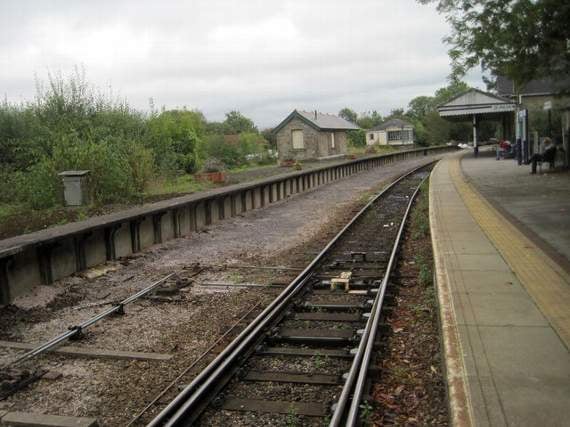
The line between Bere Alston and Tavistock North closed in 1968 as part of the Beeching Axe, but with the majority of the track still intact and under public ownership, it is a top priority to reopen and is part of the Devon Metro proposals for rail in the county.
Devon County Council now has ownership of 90% of the track and proposals to reopen the line were due to be funded by development planned for Tavistock, but as the costs of reopening the line have risen to around £94-million, a recent ‘A386 Tavistock to Plymouth Corridor Study’ concluded reinstating the rail link from Tavistock to Bere Alston, was not viable at this time.
Okehampton to Exeter passenger services were withdrawn on June 5, 1972, but since 1997 a limited service has run between Okehampton and Exeter on Sundays during the summer.
The Dartmoor Railway, the heritage rail company based at Okehampton Station, has recently gone into administration, but Cllr Davis said that it would not affect any reinstatement of a mainline service.
She added: ‘The county council has a 60 year lease to Dartmoor Railway CIC for the station building, which has limited permitted use, including a café, visitors centre, retail unit and a flat. The county council remains hopeful of seeing regular weekday rail services reintroduced between Okehampton and Exeter and there is nothing from a Devon County Council-owned asset perspective that would prevent this from happening.
‘The lease of the rail line from Aggregate Industries to Dartmoor Railway is a separate matter, which we have no influence over.
‘As the administrators have now been called in a moratorium will be in place which means that no action can be taken against the tenant for the time-being and we need to allow the administrator time to decide what steps they need to take to achieve the best outcome for its tenant.’
Cllr Kevin Ball, who represents the Okehampton ward, said that GWR was in talks with the Department for Transport (DfT) about reintroducing regular services to the line and he was hopeful of an announcement being made soon.
He said: ‘I know that GWR are in deep talks with DfT and we are hopeful of an announcement soon and I know the cabinet member has played her part in putting the pressure on them to get a response and at West Devon we passed a motion to push that way as well.
‘The northern route is a complimentary route and is about having a second route into the peninsula.
‘This fund is ideal to draw on for the Tavistock to Plymouth line and we welcome that we are going to do that.’
The Beeching Reversal Fund process was described as being a ‘bit like a game show or Love Island’ and that there would be at least two rounds of assessments for the proposals.
Any application needs to be sponsored by one or more members of parliament whose constituencies would benefit from the scheme and the group promoting the scheme could include community groups, local government, local enterprise partnerships or other interested parties.
An expression of interest from the MP is needed by tomorrow (February 28) to be considered in the first round of assessments before a short submission making the case is needed by March 16.
Successful applicants to this stage will then be asked to pitch their proposal to a panel of experts in late March.
An announcement of which proposals the Government will offer funding to will follow within two weeks.
The DfT will fund 75% of costs up to £50,000 of successful proposals to help fund transport and economic studies and deliver an initial business case, with future funding to develop projects towards delivery subject to submitting a successful business case.
Comments
This article has no comments yet. Be the first to leave a comment.