

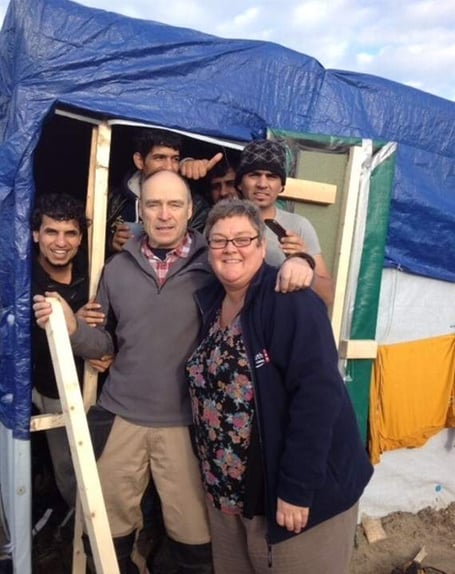
A WEST Devon carpenter loaded up his van with tools to join other volunteers to help build and repair shelters at the refugee camp in Calais earlier this month. Andrew Noquet recounts his experience for the Times.
ON a December Friday morning, Hayley and Pip from Plymouth and I drove up to Dover in a fully laden VW Crewcab. We were carrying rolls and sheets of tarpaulin — in excess of £1,000 worth. Just before the ferry we rendezvoused with eight more volunteers from Portsmouth. A brief ferry trip to Calais, a few conversations with the other people and we arrived at our hostel.
Saturday morning we drove to one of the charity warehouses through what seemed like a barren, post industrial landscape littered with high fences, barbed wire and more police and police vans than I think they have in the entire Devon and Cornwall Constabulary. We arrived at the warehouse complex, which was currently home to the ‘L’Auberge des Migrants’ organisation. Seven of our group went into the vast clothing and bedding area to do sorting, while four of us went to an open-sided warehouse out back, across a winter wasteland, which was where construction of prefab huts was taking place. There were big stacks of 2x2 timber, plywood and tarpaulins — as well as the stock of tarps we had brought.
One or two people looked like they knew what they were doing (veteran volunteers) and another 40 new volunteers milled about looking at tools. Fellow volunteer Jim and I were shown a couple of templates where large 2x2 frames were to be assembled to make up prefabricated shed sections. We got stuck in and in no time we each had an assistant working with us and I think we made productive teams — two English, one Australian and one Italian, all working quickly to assemble frames.
-found-by-the-roadside.png?width=209&height=140&crop=209:145,smart&quality=75)


We worked the day building simple frames, stacking them outside and watching them being driven off to the camp for erection and cladding. Meanwhile Hayley and Pip worked near us unrolling huge tarp rolls and cutting pieces to length ready to cover the cladding.
At 1pm we were all invited to lunch back in the main clothing warehouse.
The toilet was two huts, each with a seat above a mound of human waste — no sawdust or composting here unfortunately.
On Sunday we headed down to the warehouse for 9am. After some discussion we were teamed up with a veteran volunteer Kit, who had experience of repair work in the camp. We loaded the pick up with doors, locks, chipboard, 2x2 and tarps plus as many tools and fixings as we could find, and six of us drove down to the camp.
This was my first visit to the camp and nothing prepared me for what I saw — squalor, dirt, threadbare tents and half covered shelters, waste and rubbish everywhere and huge numbers of displaced people trying to live among all of this. I had a feeling that the people here could now wander but never leave. It looked like the worst, most impoverished living conditions from a Middle Eastern war zone had been recreated in Calais; a little corner of France was now a third world country.
We had plenty to do. Everywhere we parked the truck people approached us to ask what we had, or if we could come and have a look at something which needed fixing. I was overwhelmed, drowning in shock, outrage, anger and disgust that this could exist without structured intervention, just the tiny contributions of people like us.
My emotions were ragged; I was on the brink of tears all the time, so I was grateful that I had work to do — hanging doors to replace flimsy sleeping bag entrance covers, making frames, fitting simple locks, providing small bits of tarpaulin to cover gaps. But all the time my head was throbbing, I was shaking inside, fighting back tears, shouting inside, desperately trying to stay focused on what I had come here to do. Our team seemed aware of how this affected everyone and I was so grateful for the support and collective strength which helped us to just work on.
We roamed across the camp, back to the truck each time to retrieve more materials and tools. We explained to people not to form a line at the truck as we were not doing a distribution.
The people I met living there seemed calm, friendly and appreciative of the little things we could do. Kit explained to me that his own repair priority was to try to provide security for people. Despite the fact that many of the shelters were very flimsy, I adopted his guidance and did my best with doors and locks. We said ‘sorry’ or ‘later’ to so many people who wanted help which we couldn’t provide and left the camp after 6pm, creeping the van along dark, dirt roads full of people. This reminded me of the poorest parts of Northern Ghana I had seen, yet worse, but here we were in Calais! It was so hard to believe that this poverty and chaos existed here — an hour’s ride from Dover.
Have the French and English governments no conscience, no sense of human justice or only fear of the change which is threatening our established order as the war widens and grows in complexity? So much for Liberté, Égalité, Fraternité... All that seems on offer to people in crisis is police batons and barbed wire.
On Monday we loaded up the precious few materials and tools which we could find at the warehouse but were very short of some basics. One of the repair team had some money donated by his mother so we were able to drive to a local builders merchant and buy some of the things we desperately needed.
How quickly it seems the human being is able to adapt. This was day two in the camp and after a few hours work Jim and I discussed the fact that we were not fighting back our emotions, we were able to get on with the job without fear of being overwhelmed by tears. Relief, but had I become case hardened so quickly?
We ran out of materials quickly this day and were down on batteries for the drill/drivers so our output slowed.
My last job of the day was for two young Kuwaiti Bedouin men. One was deaf and dumb and his friend, who acted as his support and interpreter, lacked English so not a useful word was spoken. A basic sign language evolved and I understood what the man wanted — a door on their very flimsy shack which would close and lock. We had one left.
It was a challenge — I was tired, short of framing wood and a drill but somehow together we cobbled the door in place so it would close and lock.
Tuesday morning we drove to the warehouse to drop off our few left over materials and tools from the day before. We went back to the camp and visited some Kurdish families that Hayley knew. We had a few tarps left and discretely gave them to people we thought were most needy. How do you decide this in such conditions?
We met more Kuwaiti Bedouins who were stateless, paperless and so seemed stuck there. Then we were on our way heading for the ferry home.
On reflection I am aware that I had not engaged in much conversation with people in the camp, so I know little of their stories and troubles which had led them there. I just worked frantically to try to be useful to them in the few days that I had. That was my goal and with the help of many good people I guess I achieved it.
I don’t believe I could have done this by myself. I am grateful to my new volunteer friends who shared in this venture and brought their friendship and support.
One of the reasons I went is because I feel powerless to do anything about the wars which have triggered the refugee crisis, but I think that those of us who have a little time to give may just be able to make life more bearable for those who are trapped in this situation, extending the hand of friendship.
For all those people who so generously donated blankets, sleeping bags and money, thank you.
I know I will go again next year — we are already collecting for another trip so if you can help please get in touch.
Comments
This article has no comments yet. Be the first to leave a comment.