
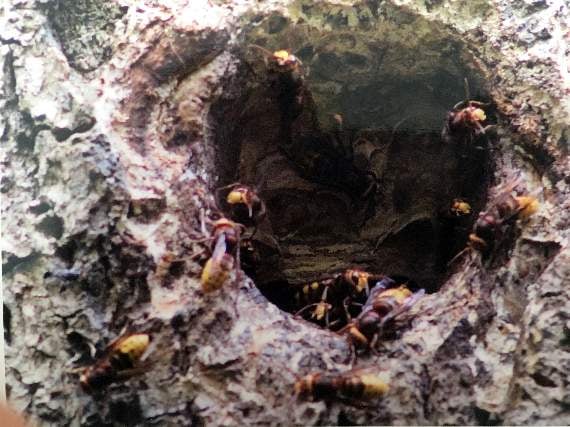
A CASE of mistaken identity seems to be leading to the persecution of the European native hornets.
A spate of reports about the threats to native nature by the invasive Asian hornet is resulting in home-grown hornets nests being destroyed.
The plight of the native hornets has come to the forefront again this week after a Tavistock resident believed he had found an Asian hornet nest in Brentor.
The nest was confirmed as being European native hornets — much to everyone’s relief.




Asian hornets are devastating to honey bees, with the invasive insects raiding and destroying colonies.
Confirmed reports of Asian hornet nests in North Devon in 2017 and in Cornwall in September have fuelled these concerns.
However, the charity Devon Wildlife Trust believes that fears over the arrival of the Asian hornet is now leading to the misguided persecution of the European hornet.
Steve Hussey, from Devon Wildlife Trust, said: ‘We’ve had several people telling us via social media that they think they have an Asian hornet nest on their property and asking can they destroy it?
‘Other people have told us that they have already gone ahead and destroyed nests, suspecting them of belonging to Asian hornets. Unfortunately, where we’ve been able to do further investigation all the cases have proved to be European hornets and not the invasive species.
‘This is really unfortunate. European hornets are a beautiful and vital part of our environment. They also help us by helping to keep in check many insect species that gardeners consider to be pests.
‘European hornets are also struggling and their persecution is one of the factors behind this recent decline.
‘Other countries are now urgently acting to conserve their remaining hornets; in Germany, for example, since 1987 it has been illegal to destroy a hornet nest. We need to look after our native population too.’
It is understood that three Asian hornet nests have been found recently, in Fowey, Liskeard and in Hull, East Yorkshire.
The Asian hornet is smaller than our native hornet and poses no greater risk to human health than a bee. However, they do pose a risk to honey bees and work is already underway to identify any nests, which includes deploying bee inspectors to visit local beekeepers and setting up monitoring traps.
Nicola Spence, Defra deputy director for plant and bee health, said: ‘While the Asian hornet poses no greater risk to human health than a bee, we recognise the damage they can cause to honey bee colonies.
‘That’s why we are taking swift and robust action to locate and investigate any nests in the south Cornwall areas following this confirmed sighting.
‘Following the successful containment of the Asian hornet incursion in North Devon last year and Tetbury previously, we have a well-established protocol in place to eradicate them and control any potential spread.’
Devon Wildlife Trust recommends that people be aware of the threat of Asian hornets and they should immediately follow official guidelines on suspected cases.
‘This means not destroying the nest and instead carefully photographing the insect without disturbing the nest and submitting an on-line sighting report to http://www.nonnativespecies.org
Mr Hussey added: ‘Telling a native European hornet apart from an Asian hornet isn’t always easy.
‘Our native hornets are slightly bigger, while Asian hornets tend to be of a darker colour, not yellow, especially on their thorax (middle section) and abdomens (tail section).
‘However, it is easy to be confused so our advice is always not to destroy a nest, but instead to report suspected sightings of Asian hornets to the Non-Native Species Secretariat (NNSS).
Comments
This article has no comments yet. Be the first to leave a comment.