
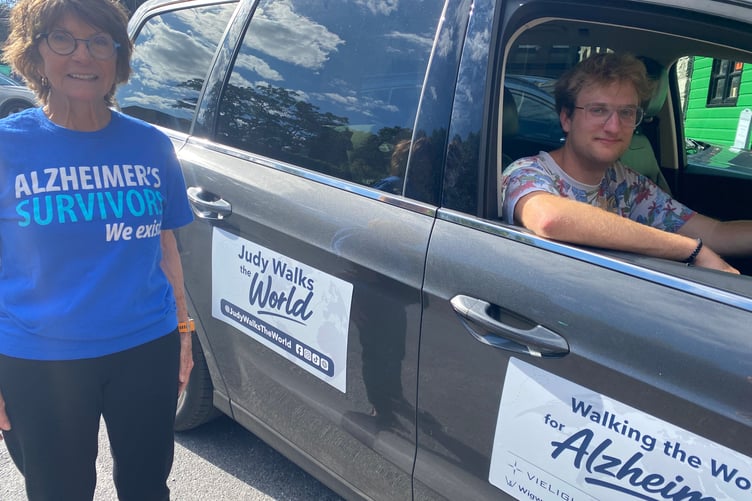
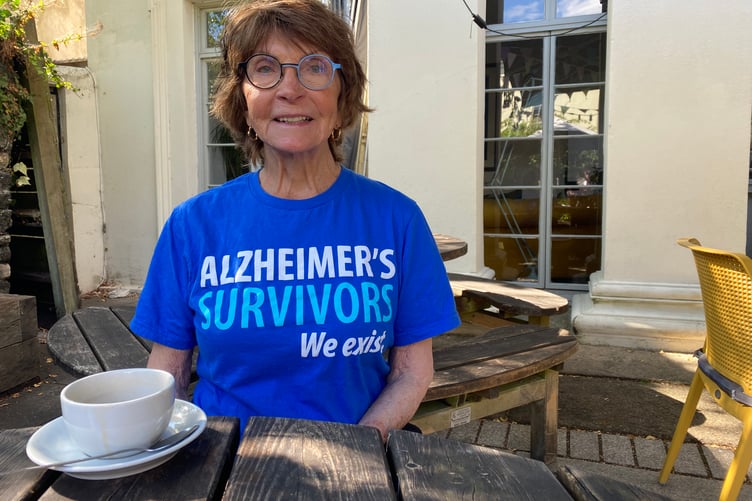
A long-term ‘survivor’ of Alzheimer’s visited West Devon on a ‘trek of hope’ to boost morale of other’s diagnosed with the disease.
Dr Judy Benjamin, 82, from the US, stopped off in Tavistock in early August after starting at Land’s End on a 650-mile journey across southern England, aiming to finish in London in mid to late September.
Judy, who was diagnosed nearly 15 years ago, is aiming to become the first-known Alzheimer’s ‘survivor’ to complete the trek while carrying a message of hope for millions affected by cognitive decline.
She says she is living, thriving and highly energetic proof that cognitive decline is no longer a death sentence: “This walk is about showing people that there is hope. Too many patients and families are told there is nothing they can do.
“I want people to understand that lifestyle, nutrition, sleep, movement, stress reduction, and identifying the root contributors to cognitive decline can make a profound difference. Alzheimer's survivors exist and it's time the world sees that.”
Along the route she is sharing her story and raising awareness of growing evidence suggesting that cognitive decline is preventable and, in many cases, reversible through a personalised, precision-medicine approach (pioneered in her home country) called ReCODE.
For the qualified anthropologist, the journey is deeply personal. Her mother endured a 20-year battle with Alzheimer’s disease, and four of her uncles also died from the illness.
Her trek across England follows her completing a 2,790-mile walk across the United States, traveling from California to Florida, becoming the first known person diagnosed with Alzheimer’s to walk across America.
Her journey helped spark broader public conversations about prevention, early intervention, metabolic health and the possibility of life after diagnosis.
Judy said when her own diagnosis was made with in 2011, when she was 67, she nearly gave up hope. Then a chance meeting with neurologist Dr Dale Bredesen changed her life. As one of the earliest patients to follow his personalised ReCODE Protocol she embraced a comprehensive programme focused on nutrition, exercise, sleep, stress reduction and identifying the underlying contributors to cognitive decline.




Judy’s pilgrimage also supports the mission of the Alzheimer’s Survivors Foundation, which she founded to advocate for individuals living with cognitive decline and amplify stories of recovery, resilience, and hope.
Dr Bredesen, an Alzheimer’s researcher, said: “Fourteen years after her diagnosis Judy continues to inspire people around the world. Her determination, resilience and energy challenge what many people believe is possible after an Alzheimer’s diagnosis.
“She is a living example of what can happen when cognitive decline is addressed through a comprehensive, personalised approach.”
The Alzheimer’s Association says the disease has no cure and is progressive with symptoms gradually worsening over a number of years. On average, a person with Alzheimer’s lives four to eight years after diagnosis, but can live as long as 20 years, depending on other factors. The association says there are two treatments which reduce cognitive and functional decline in people living with early stage Alzheimer’s. Other treatments can temporarily slow the worsening of associated dementia symptoms and improve quality of life.
Judy’s progress on her trek can be monitored by visiting this website: https://www.judywalks.com/
Comments
We've recently changed our login process. If you have an account for commenting, you will need to re-register on the login window.
This article has no comments yet. Be the first to leave a comment.