

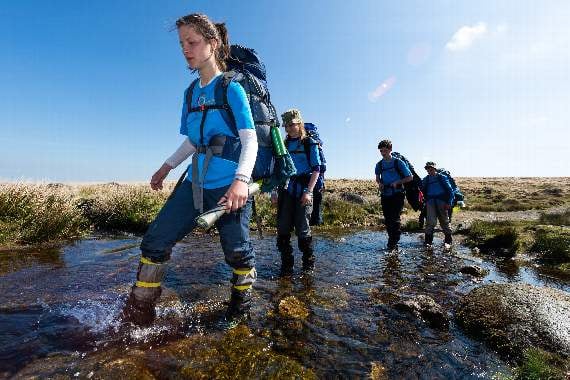
A TOTAL of 2,412 young people took part in the famous Ten Tors and Jubilee Challenges on Dartmoor last weekend as glorious sunshine heralded the finish on Sunday morning of the tough trek across the northern area of the national park.
The challenge, now in its 59th year, is one of the biggest outdoors adventure events for young people in the UK in which they are tested to their limits by trekking unaided over different 35, 45 or 55 mile routes and encountering some of the wildest landscapes and highest peaks in Southern England.
They not only have to rely on team work and navigational skills but sheer grit and determination to succeed. There can be no use of mobile phones or GPS and definitely no adult intervention.
However, safety is at the heart of the event and each team is monitored in a military operations room manned 24 hours by both military and civilian staff via a GPS tracker, which not only gives their location but also enables them to contact the organisers in an emergency.




Although known as the ‘Ten Tors’, the event has another name and another purpose as it serves as the backdrop for Exercise Wyvern Tor, a high-level military resilience exercise led by the British Army’s Headquarters South West based in the heart of Salisbury Plain in Wiltshire.
The exercise involves 1,000 reserve and regular personnel from all three services across the region along with partner agencies such as the Duchy of Cornwall, British Red Cross, Dartmoor National Park, Devon and Cornwall Police, local authorities and a whole host of fantastic volunteer organisations.
Colonel Andrew Dawes, commander of headquarters South West and director of Ten Tors said: ‘I think this year’s event has gone brilliantly; I could not have asked for better. It was partly the conditions which have been spectacular but actually it was about how all of the agencies, volunteers and service personnel came together to deliver this event. That is what I’m most pleased about; the seamless delivery on this scale to more than 2,400 of our young people from across the South West was really inspiring.
‘Every year is a rehearsal for the next year and I’m not giving anything away but the 60th does need marking. It is really significant that an event like this can exist in this crazy world of ours for 60 years and get better and better. Let’s just hope for conditions similar to this weekend but we will look to bring you an amazing event.’
The rural affairs minister, Lord Gardiner was invited to fire the artillery starting gun, the signal that signified the culmination of months of demanding training required for the arduous challenge and for many of the participants their first real ‘hands on’ experience with the national park.
Lord Gardiner said: ‘The famous annual challenge is aimed at giving young people confidence and inspiration from nature and it is rooted in the unique landscape of Dartmoor.’
After the start of the main event, 309 youngsters with special physical or educational needs started the Jubilee Challenge which they all completed. The youngsters — many in wheelchairs — entered either as teams or as individuals and covered routes of up to 15 miles; they were each accompanied by an officer cadet from Exeter University Officer Training Corps.
The first of the Ten Tors teams crossed the finish line at 8.30am on Sunday. The Sidmouth College 35-milers were greeted by whoops of delight and congratulations from the huge crowd of well-wishers.
Wellington School were the first finishers on the 45-mile route and for the third year in succession the inspirational Torquay Boy’s Grammar School completed the 55-mile ‘Golden’ route ahead of their fellow trekkers.
Captain Lou Rudd, serving with the Parachute Regiment, and the first Briton to transverse Antarctica solo, unassisted and unsupported, was one of those who presented medals to some of the finishers.
The majority of the teams who enter Ten Tors are from schools and youth groups from across the South West. These include scout groups, sports and ramblers teams and Armed Forces cadet units, all of whom have prepared and trained hard since late last year.
They do it to test themselves against one of the last remaining wildernesses in Britain.
What they get in return for their months of hard training and commitment, as well as determination and bravery during the event itself, is an experience they’ll remember forever and the chance to learn a set of skills and values which they will carry with them throughout their lives.
Over many years, the challenge has played a positive and formative role in shaping the lives of more than a quarter of a million people.
Pick up your copy of this week’s Tavistock Times or Okehampton Times for pictures of the local teams who took part in the challenges by James Bird.
Comments
This article has no comments yet. Be the first to leave a comment.