
UNKNOWN faces peer from the murky gloom of a First World War trench in a rare, unofficial glimpse of life on the western front.
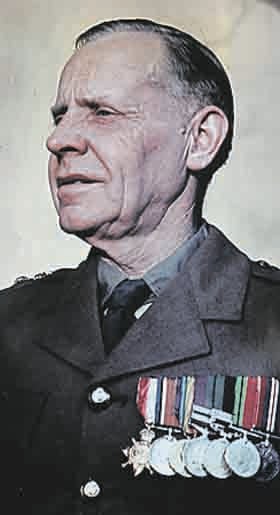
Behind the camera stood Lieutenant Robert Monypenny, 25, a veteran by the spring of 1915 when the photos were taken.
The identity of the men pictured is not known although they, like him, served with the Essex Regiment and were about to endure the wanton carnage of the second battle of Ypres, when Germans experimented for the first time with gas warfare.
He had the six-frame film smuggled back to London and the miniature prints were later inherited by his daughter Sheila Ford, now 87, who lives in Chagford.


Along with letters home and a personal memoir penned in exercise books decades later she finally had an insight into a life that unfolded years before she was born.
'He didn't talk about his experiences in the war to his family,' she explained.
'Soldiers at that time didn't. It was only after he died when I read carefully what he'd written that I realised what he went through.'
The images were captured on a Kodak Autographical, first made in 1914 and known as 'the soldiers' camera' for its popularity among servicemen who used it like a diary to record events.
It's thought the film was delivered to his London home in the spring of 1915 by a platoon sergeant on leave.
In an undated letter to his aunt he wrote: 'Here is a roll of six exposures which I have taken under fire. If you get them developed at some insignificant place and take precautions they don't go to the press, they might be done straight away.'
Permission to use cameras was given by individual regiments and soon the top brass of many thought better of it.
By March 26, 1915, Lt Monypenny had told his aunt: 'I am sending my camera home, as a strict order has just been issued that no officers are to have them. Any we've got we must send home.'
Two months later he was still regretting the 'ridiculous order' that deprived him of his camera as the battle raged around him. Ultimately, 70,000 allied servicemen were killed or wounded in the battle.
'Cameras were seen as a security risk,' said Alan Wakefield, head of the photography section at the Imperial War Museum, but some remained on the front line at the discretion of commanding officers.
'There were more restrictions on the western front than elsewhere,' he said. 'There the Government brought in official photographers from 1916 to control what images were seen in the British press. Until that point some private photographs were being sent back and sold to British newspapers and magazines.'
Although cameras like his rarely captured action shots they recorded the conditions faced by fighting men.
Robert Monypenny died in 1991, aged 99. Younger brother and fellow officer Phillip, who won a Military Cross, died in 1918 before reaching his 21st birthday.
Lt Monypenny – known as Robin – was born on a tea plantation in India. From the age of 12 he was looked after by his Aunt Ethel.
The eldest of six brothers, he joined the army in August 1914 at the outbreak of war.
Throughout the conflict he wrote home regularly. Almost every note asked for items to share like tinned milk, cocoa, currant cake, preserved fruit, plain chocolate, packet soup, newspapers, razors, carbolic soap, notepaper and envelopes.
His letters, subject to censorship, are a distilled version of the compelling story he wrote much later.
On May 2 the Germans unleashed chlorine gas on British-held trenches. It wasn't until July that year that the first rudimentary gas masks were given to soldiers.
Until then soldiers caught in a deadly gas cloud were effectively drowned on dry land.
Later Lt Monypenny recalled: 'The only protection we had was a small square flannel issued to each man, dipped in some ammonia solution, but it was ineffectual.
'Everyone was coughing and wheezing and fighting for breath. Men began to roll down into the bottom of the trench in their agony, the worst place to be as the heavy gas tended to collect there . . .
'I could not shout or even speak I was fighting hard for breath, which became shorter and shorter. I noticed the nearest machine gunner doing his best to work his gun. I happened to look over the parapet to see what he was trying to shoot at and, to my horror, across the mist I could see forms approaching.
'I stumbled to the gunner's aid but by this time we were both far too gone to use the gun. I felt as if my lungs were bursting or being torn out of my mouth. Everything swam in front of my eyes. I reeled and there was merciful oblivion.'
While he was unconscious British forces dashed into the trench and there was hand-to-hand combat before the enemy was ejected.
Lt Monypenny was hospitalised for a few days before re-joining his unit.
He told his aunt: 'I am pretty fair again, my lungs being still a little queer. Wasn't bad enough to go away from duty, however. I know a little more about chemistry now.'
Prior to the gas attack - after watching two battalions of Gurkhas get blown to pieces in a failed offensive - he had received orders from Battalion headquarters to attack the Germans in the middle of the afternoon with 70 men.
He was dumbfounded, knowing it meant certain death. By telephone he learned the order had already been queried – and confirmed.
'I hardly dared face my men with such a proposition. However, I got them together and explained the matter the best I could. I might as well have told them they were all going to be put against a blank wall, including myself, and be shot out of hand by a firing party. However, I made certain orders for formation attack, the whole thing seeming so utterly futile with such a minute force.'
Just 30 minutes before he was due to lead two platoons into no man's land he received a message cancelling the order. No reason was given.
At the height of battle he was deafened by daily bombardments. 'Every now and then there would be a tremendous boom ending up in a sort of metallic twang and miles overhead would rush what sounded like half a dozen express trains and at the end of it a terrific roar and away in Ypres somewhere a great hole would be torn.
'This was a new 17 inch gun (the Germans) had produced and it used to be fired regularly every afternoon.
'There goes the "Wipers Express", the men would say. It must be somewhere near four o'clock.'
'Later on, down in the outskirts of Ypres, I came across one of these shell holes and it must have been 50ft across and 30ft deep. You could drop a fair sized house in it.'
He was soon promoted to captain and moved to a new unit.
'The ceaseless shelling began to tell badly on us and we had to grind our teeth to try and bear it. Our nerves were strung to an excessive pitch. Quite a number of men went mad,' he remembered later.
One wild-eyed man took the bayonet from his rifle and lunged at Lt Monypenny as they both cowered in the trench.
'I managed to seize his wrist but he had the strength that madness gives. My sergeant tackled him from behind and we pinned him to the ground then tied his arms and legs with his puttees (a strip of cloth wound between ankle and knee).
'He was stark, raving mad. His brain had snapped. A shell landed on him later and his worries were over.'
On May 20 he wrote to his aunt. 'I wish I was home however for tennis and sea bathing etc. This is no gentleman's war, simply scientific cunning and bestiality. However I pity the German that comes anywhere near an Essex bayonet.'
During a foray into enemy trenches Captain Monypenny was injured in the head and shoulder by a shell. When he was told he was going back to 'Blighty' in July he was flooded with relief.
'Those months at Ypres had been a terrible strain, mentally rather than physically, though the physical conditions had been far from any picnic.'
Later Captain Monypenny returned to the western front, only to be injured a second time in 1917. He then transferred to the Indian Army and later left to pursue a variety of jobs.
He went on to serve in the military in World War II, helping to train officers. Despite his early interest, he never returned to photography as a hobby.
Aunt Ethel treasured his letters until her death when they were returned to him and remained largely unread until they passed to Sheila and her children.
Her son Simon Ford said: 'As a boy I would sit for hours listening to his stories.'
It was another son Tim, a university professor in America, who painstakingly transcribed the letters and memoir.
'I think my father wanted his story to be told,' said Sheila.
Comments
This article has no comments yet. Be the first to leave a comment.