
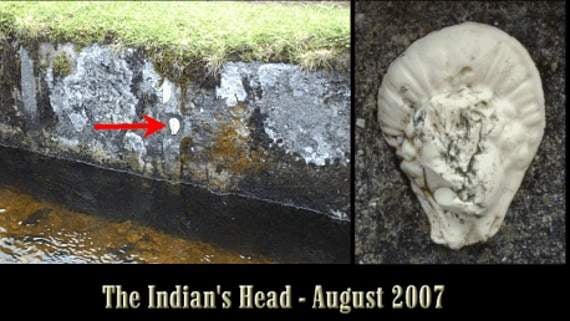
A FAMOUS Dartmoor curiosity has gone missing from Devonport Leat, above Burrator.
Walkers who follow the leat up to the aqueduct at Black Tor Falls have for decades enjoyed hunting and spotting the tiny ornament of a Native American chief’s head on the leat walls just above water level.
Historians and Dartmoor enthusiasts are divided over its origin but the most well-known version is that the miniature was carved by an American prisoner of war incarcerated at Dartmoor Prison after the war of 1812 between Britain and America, which lasted 32 months.
The story is that while undertaking forced labour repairs on the leat walls one of the prisoners may have embedded his handiwork into the granite stone.


.jpeg?width=209&height=140&crop=209:145,smart&quality=75)

Unfortunately, the original carving was lost many years ago and a replacement was installed.
A spokesperson from Dartmoor National Park Authority said: ‘We are aware that the replacement plaque for the original has now gone missing. We’re looking into seeing whether another can be made.’
It seems the history of the small porcelain plaque has been told in many varying degrees over the years — the truth may never be discovered but what are the stories behind the origin of the artefact?
Legendary Dartmoor (https://www.legendarydartmoor.co.uk) said that the first literary mention of the Indian’s Head comes in 1982 by John Robbins.
‘...A Red Indian... only about two inches in diameter... looks rather like white marble... but beautifully carved. It has an obvious Indian head dress. It is thought to have been put there by one of the French prisoner-of-war when working on the leat and is typical of the style of doll’s head of the period.’
Legendary Dartmoor added: ‘If Robbins’ supposition is correct then the first French prisoners arrived at Princetown in 1809 and the last ones left in 1816 so it would mean that the Indian’s head was possibly placed in-situ somewhere between those dates.’
Legendary Dartmoor added that a different theory was put forward by D J Hawking who suggested that it was embedded in the wall during repairs that were being made to the leat in the 1830s. He said that the head was defaced sometime during 1984. Mike Brown explained that in 1996 a replacement for the original head was cemented into the wall.
Another person said that when work finished on the raising of the dam in 1928 workers were given employment by the Plymouth Water Works Department to repair the leat. One day, while on a break, one of the men took out the dolls head from his pocket and got into the leat and put it in the wet cement. Asked were he had got it from he said that a friend had returned from America and gave it to him as a keep sake.
Comments
This article has no comments yet. Be the first to leave a comment.