
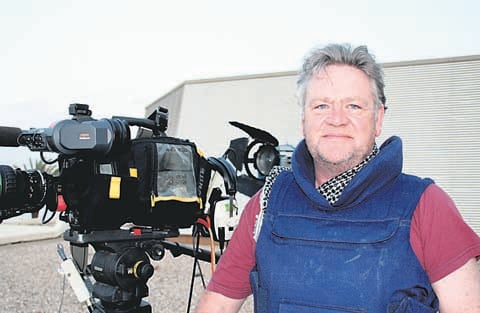
WEST Devon cameraman Pete Atkinson is today (Thursday) at the centre of history-making events, as he starts a new five-week assignment in war-torn Tripoli.
Pete only came back from the Libyan capital on August 11 after spending more than a month filming for Associated Press — but when the offer to return came on Monday morning, he jumped at the chance.
He said: 'I was talking to one of my colleagues and he said "You lucky devil — get out there!"
'There will be a certain amount of nerves, it will be dangerous getting in to the city because we will be going in with the rebels — we will be taking flak jackets this time.'



For his last stay in Libya, Peter was based at the Rixos Hotel. When he spoke to the Times just before he left the UK, he was expecting to return there, but as the paper went to press, the hotel was described as being in a 'siege situation', with pro-Gaddafi guards patrolling the corridors.
Peter described the hotel as 'a gilded cage'.
'They took our passports before we got there, you can't leave, and you are bombed every night.'
Peter said living through the Nato bombing raids were 'surreal' experiences, and particularly close encounters were a feeling like no other.
'The whole air moves, the double glazing bends inwards and outwards again, and the explosions are very, very loud, particularly at night.
'Four nights before I left they hit a munitions dump and the explosions that came out of that were amazing.'
Peter said although everyone was aware that the bombs were high-tech and guided, it was still frightening waiting for them to detonate.
'The stupid thing is, most sensible people head for cover, but we go up on the roof with our cameras and take pictures! You are there for at least two hours, and then when you head down, although your body is tired, it takes a long time to come down from the adrenalin high.
'We had to go to Green Square at one stage and I spoke to some of the local people and asked them if they were frightened.
'They said they weren't because the bombs were so technically advanced, they are hitting very specific targets.
'There are still cars going up and down the street, people aren't running away,' said Peter, who said gunfire was far more of a hazard.
'Unfortunately the rebels aren't that well trained — and many of them believe if they fire into the air, Allah catches the bullets! If one of them comes back down and hits you on the arm, say, it would take it straight off.
'Two photographers were killed in Benghazi when I was there earlier this year and that was really just being in the wrong place at the wrong time.'
AP have been providing the shots for journalists from all over the world from their live standpoint on The Rixos roof — but Peter said a lot of his last assignment was actually 'very boring', consisting of sleeping, watching DVDs, eating and then filming the bombing raids during the night.
The crews try to stay in contact with the world outside the hotel via mobile phones and the internet, but these were constantly hacked by members of Col Gaddafi's forces, said Peter.
'They'd also call press conferences at ridiculous hours — they were just trying to grind us down really,' he said.
He believed most ordinary Libyans' dearest wish was a swift return to normality — whoever ends up governing the country.
'The people of Tripoli are worried about the outcome, but they just want it sorted out.
'You are talking about a city of two million people, that's the population of the South West.
'They want to get on with ordinary life again. All building has stopped there, the airport's closed, all sorts of projects have come to a stop because people have been pulled out of the country.
'They are in limbo and I don't think people generally want to fight, they want to get back to work — I think that's why the rebels pretty much sauntered into Tripoli at the weekend,' said Peter.
'I don't know what's going to greet me this time. I think they are moving our live point to a different area and hopefully we will be able to get out, which will be good.
'I think it's going to be very interesting, and it's good to feel I am recording history.'
Comments
This article has no comments yet. Be the first to leave a comment.