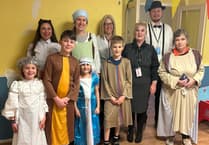
CHILDREN at a West Devon primary school are throwing their weight behind a scheme to protect one of the world?s most endangered species. Money collected after the school?s Christmas production of Oliver! has been donated to the the Institute Congalese de Conservation de Nature (ICCN) and the Diane Fossey Gorilla Fund of Europe (DFGFE), which are working to protect incredibly rare gorillas in Africa?s oldest national park. The inspiration behind the donation is Rob Poppe, who is working with the ICCN ranger training programme in the Democratic Republic of Congo. His fiancee, Caroline Smith, is a year 4 teacher at Whitchurch School. Caroline said: ?They have been fascinated by the project. They?ve seen Rob?s photos and they can?t wait until he comes into school.? She said the children at Whitchurch were ?well behind? the project and their Christmas effort raised £187. Rob said: ?Some of the money raised will go out with me to Africa, some is being spent on some of the rangers, that don?t get a salary. ?We are buying some clothes, toys and educational stuff for the children and some of the money will also be spent on solar panels to recharge batteries.? Rob said the rangers who protect the gorillas have to walk eight hours from the gorillas? habitat to recharge batteries ? leaving the endangered animals with no protection. ?The solar panels means they can sit on the mountain and not leave the gorillas. It saves them a long walk and also maintains the watch on the gorillas,? said Rob. The Congalese national park is home to a huge variety of animals, including elephants, antelopes, buffaloes and hippos. Most endangered of all is a tiny colony of Eastern Lowland gorillas. These unique animals are slightly larger than the famous mountain gorillas made famous by the film Gorillas in the Mist, who live in a tiny pocket of land in the mountains that border Rwanda. There are only 20 of these lowland gorillas, guarded by dedicated ICCN rangers, helped by a project funded by the zoological societies of London and Frankfurt with backing from the EU and other bodies. Rob is helping train these dedicated guards, who exist on just 70p a day. But Rob, who returned to the Congo this week, says the national park scheme is already beginning to bear fruit. Where animal populations had been decimated by war, the illicit ivory trade and de-forestation, changes are already beginning to take place. ?What I am doing is direct, it?s on the ground and we are seeing results,? he said. ?Animals are coming back in. We are seeing vast increases in population in the area where I am working, bird life has increased, hippos are mating because they are feeling comfortable. If they increase, the dung increases in the lake, then the fish increase, then there is more for the people living in the area.? Rob said for the moment, the tiny group of lowland gorillas, the last of their species, were safe. At one point their population had dwindled to just eleven ? their numbers have now increased to 20, but it will be another year or two before any babies arrive.

.jpg?width=209&height=140&crop=209:145,smart&quality=75)