
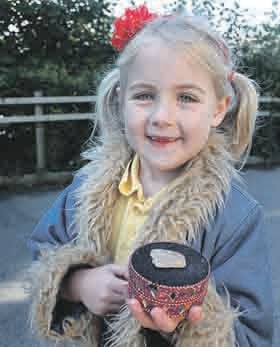
A?SIX-year-old from?Hatherleigh has unearthed a unique archaeological relic while tending her primary school's vegetable patch.
Amelie Campbell discovered a late Bronze Age scraper among the runner beans in Hatherleigh Primary School's garden.
Her father, Drew, who has just completed a doctorate at Leicester University, is researching the history of Hatherleigh and thought the relic might be of historical importance.
It has now been identified by South West Archaeology in South Molton as a general tool that would have been used for scraping meat from hides and for other jobs that required some form of cutting.




It is believed to be one of the oldest man-made implements found in Hatherleigh. The oldest man-made object discovered there is a flint dating back to the Neolithic Period —between 4,500BC and 2,300BC — by a member of Hatherleigh History Society.
Hatherleigh School headteacher Caroline Boother said the scraper was found in soil that had been donated to the school by building contractors. The earth had been taken from an area that was being developed for housing 200 metres north of Hatherleigh Church, which indicates that this was where the Bronze Age tool was originally dropped.
The find has sparked an interest in history among children at the school.
Caroline Boother said: 'It is an amazing story really, with all the coincidences. The chances are that if a child were to find something like that and put it in their school bag, that it gets lost, or thrown away, or just not recognised for what it is.
'It just makes you wonder what other things could get lost like this just because they are not recognised for what they are.
'It has been nice for the school to be involved in something as historically significant as this.
'The nice thing is, since the other children found out about this, they have all been out in our vegetable garden, digging up the soil and looking for treasure of their own. So now we have a box of things that may or may not be fragments of something historically important that need looking at.'
The irony about Amelie's discovery is that Dr Campbell had been out on Hatherleigh Moor looking for the remains of a Roman tilery but had been unsuccessful. Amelie was sympathising with him about the fruitless search and pulled the scraper out of her bag to show him the treasure she had found herself, beating him by at least 2,500 years with her discovery.
Dr Campbell said: 'This tells us that there were late Bronze Age people walking what are now the streets of Hatherleigh sometime between 1,000BC and 750 BC.
'It confirms Hatherleigh had a prehistoric presence which continued on to the late Bronze Age' said.
'Place-name analysis informs us that Hatherleigh's history dates back as far as Saxon times as it means 'hawthorn glade' or clearing.
'The area where the scraper comes from would certainly have been strategically a good place for a settlement as it commands an excellent view of the surrounding area.'
The discovery of such historical treasure has certainly excited Amelie — she is now learning about other aspects of life for Bronze Age people, which has included a visit to the Bronze Age remains of Grimspound on Dartmoor, and she says she wants to be an archaeologist when she grows up.
Comments
This article has no comments yet. Be the first to leave a comment.