
CAN you imagine living in a country where the average life expectancy is a mere 32 years of age?
An amazingly beautiful country— but one where nearly half the population suffer from an incurable disease?
Michael Collinson and his wife Linda live in such a place — Swaziland — and are doing their level best to lift the curse of HIV/AIDS from future generations living in their adopted country.
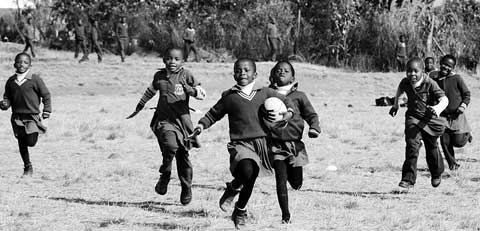
Michael set up the SKRUM (Swaziland Kids Rugby Mission) charity three years ago. The aim is to educate Swazis on health awareness topics, concentrating on HIV/AIDS education and gender violence through the medium of sport — specifically, rugby — now that the HIV/AIDS infection rate has reached 42%, the highest in the world.


Michael said: 'I have been fortunate to have travelled throughout Sub-Saharan Africa over the years with business and rugby.
'I'm also very fortunate to have a very, very understanding wife who understood the need for me to be away from home!
'On returning home from each trip, Linda and I would load up a large cooler box with wine and food, jump into the "Blue" — an old Range Rover which is blue — and drive off into the mountains. We had no maps or destination, we just drove.
'After being away in some really rough, tough and not too nice places in Africa, to be out in the beautiful Swazi countryside was just marvellous and rejuvenating.
'We would meet so many kind, generous and interesting people, who at first were surprised to see a white couple in the middle of nowhere, but after the initial surprise, they welcomed us into their homes and homesteads.
'Often we would stay out overnight, sleeping in the Blue parked at a friendly homestead. In the evening we would have a braai — or as the English would say, a barbeque — sitting around a fire talking to whoever lived in or around the homestead. I don't think there is a part of Swaziland we didn't visit.'
Life changed irrevocably for Michael and Linda, when a car accident on Boxing Day 2002 left him paralysed.
He could no longer travel as he did and the impromptu drives out stopped.
By June 2005, Linda, increasingly frustrated by Michael's boredom and brooding, had had enough. A 4x4 vehicle was loaded up and she drove Michael out into the countryside.
Michael said: 'What greeted us was a shock. Homesteads we would visit, people we once knew had gone. The houses were in ruins and all traces of the people who had once lived there had vanished.
'This was repeated everywhere we went. The countryside was still beautiful, but something was missing.
'I began asking questions and in true Swazi fashion, I was told the family had "moved on".
'As I asked more and more questions the reason became more clear.
'At that time the HIV/AIDS infection rate in Swaziland was 38%, second only to Botswana, on 39%.
'The last Government census said there were 1,200,000 Swazi's living within the borders of Swaziland. A census taken in 2006 suggested a figure of 958,000! Where had 250,000 Swazi's disappeared to?
'I couldn't believe the figures, but was assured they were accurate. Asking yet more questions about HIV/AIDS education, I was informed there was little or no HIV/AIDS education for young Swazis. There was some information for adults, but nothing for the youth.'
These incredible statistics sewed the seeds for SKRUM, as Michael set out to find some way of getting the health awareness message out to young Swazis between the ages of seven and 19 who, if the figures were to be believed, were not yet infected with HIV/AIDS.
Michael said: 'We needed to get the message across of how you can contract HIV/AIDS — and also more importantly, how you can't get HIV/AIDS.
'Eighteen months of planning went in to making sure that once started, the SKRUM programme would work from day one and carry on working for as long as it takes. February 1, 2007 was the day we kicked off SKRUM and we haven't looked back.'
Now well and truly up and running, SKRUM coaches visit schools throughout Swaziland, introducing the SKRUM programme to the head teachers.
Michael said: 'We use rugby as the vehicle to get the youngsters interested and involved. I'm the president of the Swaziland Rugby Union and having thought long and hard, I realised that rugby being the game it is, includes everyone.
'One of our mottos is "Fat, thin, tall, small — we take them all".
'While coaching we bring in catch phrases such as "Pass the Ball NOT the Virus" and "Hit the Gap NOT the Family"
'We hold discussion groups and give out leaflets which have the necessary HIV/AIDS awareness education. How you can and how you can't get HIV/AIDS.
'We give away rugby kit which we have branded with the SKRUM logo, to constantly remind the youngsters of the SKRUM programme message.'
Michael said during the last 20 months, SKRUM had given away three tonnes of rugby kit.
The kit is donated by the SOSIRBKitaid Programme and the last delivery contained a large amount of kit donated by rugby clubs and people from Devon.
'A huge thank you must go to Nigel Larcombe-Williams who started the ball rolling for kit donations at Tavistock Rugby Club,' said Michael.
At present, SKRUM has two full time coaches and one trainee. As funds become available, the charity hopes to employ a further two fulltime coaches. They also have two vehicles.
Michael said: 'The reaction to the SKRUM programme from everyone we visit has been beyond our wildest dreams.
'We have been turned down by two schools — who then two weeks later phoned and apologised and asked us to return and introduce SKRUM. '
He said the Swaziland Schools Sports Association were fully behind them — they now seek backing from the Swaziland Sports Council and Swaziland Olympic Committee.
So far, SKRUM coaches have visited 283 schools, painting the SKRUM programme logo on walls at 70 schools. They have trained 178 teacher/coaches who not only coach rugby at their respective schools, but also help carry the SKRUM programme message.
Through the charity's bumper sticker programme, the SKRUM 'Pass the Ball NOT the Virus' stickers can now be seen on 2,000 buses, taxis and cars, 1,000 in English and 1,000 in SiSwati.
The charity has reached more than 22,000 young Swazi's between the ages of seven to 19 and introduced them to rugby and the SKRUM programme.
Michael said: 'Everyone we speak to tells us we are making a difference and an impact.
'Young Swazi's are now discussing HIV/AIDS and gender violence, in part thanks to SKRUM and the SKRUM coach's efforts. I truly believe we are making a difference — but only time will tell.'
So how can people in West Devon help this small, but vitally important charity?
Michael said: 'I'm sorry to sound like an old record, but for the SKRUM programme to work on a day to day basis and to carry on doing its work effectively we require funds.
'We have had a young boy donate the money from his birthday party, schools have held "mufti" days, people have held cake sales, we have even had people do sponsored bungee jumps, cycle rides, run half marathons and swims.'
Michael suggested that schools could adopt SKRUM as their charity for a year. In December the SKRUM programme in the UK launched the SKRUM 200 Club. People are asked to donate £200 a year paying £16.66 pounds a month by direct debit.
To join the SKRUM 200 Club all you have to do is contact the SKRUM trustees in the UK by going onto the SKRUM website.
Michael said: 'Every little bit helps and ALL the money donated goes to the SKRUM programme in Swaziland.
'We would like to forge partnerships with schools, rugby clubs or anyone who would like to be a part of what we are doing.
'We have also launched the SKRUM Gap Year Programme and anyone interested should visit the SKRUM website and find out more information.
'Tavistock Rugby Club have been very supportive and we must say a huge thank you to everyone at Tavistock for their help. We now have young Swazi's running around playing rugby in kit donated from people in Devon — it's marvellous!'
Michael said phase one of the SKRUM programme was the introduction and the effective running of SKRUM within Swaziland — this was being achieved and SKRUM was growing on a daily basis.
'Phase II would be to buy land in Swaziland and build a school where we can give a good all round education and teach life skills such as farming.
'This will enable the students to grow their own vegetables and fruit at their homesteads and provide food for their families.
'Phase III is to introduce the SKRUM Programme into other needy countries.'
Michael, a Yorkshireman who moved to Swaziland in January 1986, said the SKRUM story almost felt as though he had come full circle.
'In 1997 I bought the company I worked for, which sold laboratory and medical equipment.
'One of the first projects the new company became involved with was the setting up of a central HIV/AIDS Clinic at the Central Health Laboratory in the town of Manzini. My company were the agents for the pharmaceutical company Boroughs Wellcome, who supplied HIV/AIDS test kits and laboratory testing equipment.
'The first HIV/AIDS positive tests were carried out at the Manzini Central Health Laboratory.
'When I was putting the SKRUM programme together I never thought of those early days. It wasn't until I watched the SKRUM promotional DVD which was put together in the UK, I realised that the first HIV/AIDS positive case in Swaziland was tested in 1987.'
*l For more information on SKRUM, go to http://www.skrum.org">www.skrum.org
Comments
This article has no comments yet. Be the first to leave a comment.