

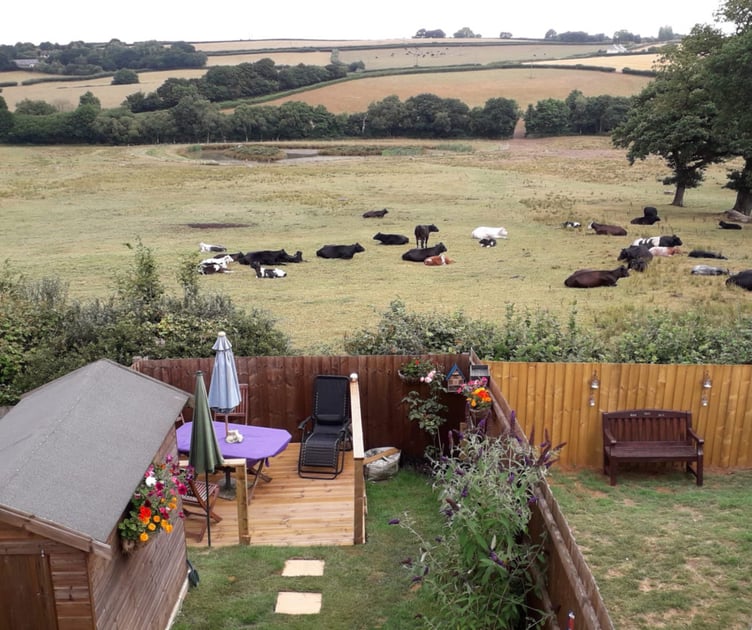
An Okehampton resident has raised concerns about the decrease in wildlife at Meldon Fields following the start of construction work on a new housing development.
Claire Hardy, whose house backs onto the new Okement Park housing development, reported that she had noticed a massive decrease in the number of birds, bats and other animals visiting her garden and the surrounding area since building work began. She said that the usual ducks, Canada geese and frogs that visited her garden had been noticeably absent this past year.
’I understand that it’s necessary, we need the houses; it’s just a little bit of a concern when we need to help the environment.
’When we first moved here we watched a pair of buzzards raise their young but they haven’t come back since the building work began. It was really really lovely to see them and we just hope they don’t go forever. I hope that someone is standing up for the wildlife,’ said Mrs Hardy.


.jpeg?width=209&height=140&crop=209:145,smart&quality=75)
A West Devon Borough Councillor explained that as part of the planning permission procedure a conservation plan needed to be provided in order for a development to receive the go ahead, but still understood Mrs Hardy’s worries.
The councillor said: ’I understand her concerns. All [developers] have to provide a conservation plan. We have to have progress but we should be looking after our natural environment, especially our beautiful natural environment in Devon which is often taken for granted.’
As required in law, an environmental survey was carried out on the Okement Park development site prior to building work to assess the impact of the construction on the wildlife and to suggest ways to mitigate any negative effects.
A spokesperson from Barratt Homes, the development company heading the construction work, said: ’As part of the planning process, we carried out extensive ecological and arboricultural surveys to record species and habitats on-site. These surveys looked carefully at the range of species present and how we could protect and enhance their respective habitats.
’We also sought out the advice of the local authority’s biodiversity specialist, to help develop a comprehensive Biodiversity Enhancement Plan that was submitted along with the planning application.’
Mrs Hardy said she had experienced problems caused by loss of habitat. She said that her family had suffered from a rat problem as the hedgerows were cut down and affected animals forced into an ever smaller space which included the neighbouring homes and gardens.
’We were also overrun with rats for a while. I think they’d been forced out from the field when the workers came,’ Mrs Hardy said.
Barratt Homes has promised to plant replacement hedgerows within the new housing estate to compensate for loss of habitat and to ensure that animals can move safely around the site
Mrs Hardy has also become concerned about the loss of trees in the area and has taken action to place a preservation order on several oak trees at the edge of the site.
She said: ’A preservation order was put on the oak trees about two years ago because there were people looking at them and I was worried because oak trees are usually full of wildlife.’
As part of the mitigation strategy, Okement Park developers have agreed to provide new areas of grassland, rough grass and scrubland across the estate and plant extra trees and shrubs around the estate’s perimeter to reduce light pollution in the neighbouring habitats that may affect wildlife
Every new home will also be fitted with a bird or bat box.
The Barratt Homes spokesperson added: ’We will encourage residents to make their gardens as wildlife friendly as possible by providing a ’Residents Biodiversity Pack’ as part of their welcome bundle when they move in.
’The measures we are taking will play a major role in protecting and enhancing local wildlife for years to come while creating a high-quality community that provides much-needed new homes.’
Comments
This article has no comments yet. Be the first to leave a comment.