
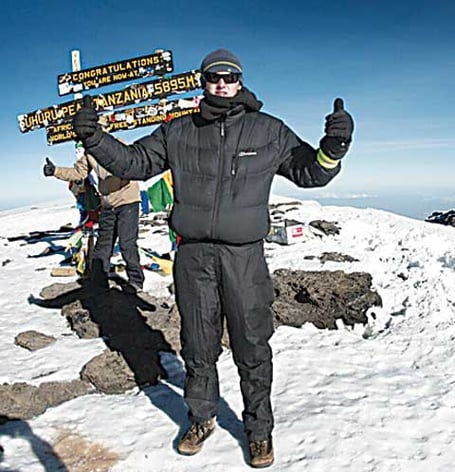
A WEST Devon father and son have completed the challenge of a lifetime, by conquering the highest mountain in Africa during a seven-day charity trek.
Jacob and Tim Gibbins' trek to the 19,341ft summit of Mount Kilimanjaro in Tanzania would have been gruelling in itself — but the adventure was even more of a challenge for Tim, who is registered blind. He has lost 80% of his vision to the condition retinitis pigmentosa and has lost all his peripheral vision.
'I have reasonable core vision in good light, but at night time I am blind. My core vision is going slowly, but no-one can tell me how long I will have useful sight for,' said Tim, 57. 'I can function in my own surroundings, but put me in a supermarket, an airport lounge or anything and I am absolutely hopeless. I struggle in any crowded situation and avoid crowds at all costs, so it is very limiting.'
So, putting Tim's perspective on the adventure which lay before them, it's easy to see how much of a challenge the trip was going to be. Just the bus trip to Heathrow and flights to Addis Ababa and Kilimanjaro were hard enough, without seven days of hard slog in alien terrain, with rudimentary overnight camps.

Tim, from Tavistock, said: 'They took very good care of me, and Jacob was always on hand when I needed it, but basically, on the trek, I had to literally follow the footsteps of our guide, Nelson. I literally had to stare at the ground and make sure I didn't trip over. I couldn't appreciate the landscape — if I wanted to look at anything I had to stop walking.'
As the party of trekkers walked ever upwards, they encountered widely differing climates — from the incredible heat and humidity of the first day, to the increasingly cold conditions further up the mountain. At night time, the flysheet of the tents would become sheets of ice.
The going changed from rain forest tracks, through deep stream-filled valleys to barren, rock-strewn plateaux. Then there was the altitude.
The journey started at 2,780 metres above sea level and with every step, the walkers gained altitude — which can severely affect some people — even the fittest.
As if Tim didn't have enough to contend with, altitude sickness soon attacked him in earnest.
Right from the beginning of the trip he had suffered with diarrhoea, but the higher he walked, the more nausea would strike.
He said: 'I ceased to eat because I just couldn't keep any solids down — I ended up on porridge and soup for four days.'
On the final day, before the last ascent, Tim was examined by the doctor.
'My vision was going, I felt lightheaded and my speech was slurred. He left it up to me whether I continued or not, but having come so far, I wasn't going back,' said Tim, who by this time reckoned he was "running on empty." I don't think anyone thought I was going to make it — somehow I managed to struggle up the last slope,' he said.
In temperatures of -15c and with a 50mph wind blowing, the party did not stop long to celebrate on the snow-capped summit and before long they were heading back down the scree. The downward journey was every bit as tiring, and particularly hard on the thighs and knees. Tim ended up on antibiotics — but the dreaded altitude sickness at last started to subside.
Tim said it felt 'really good' to have conquered the mountain with his son.
'When we first planned this expedition Jacob talked about father/son bonding. I had my doubts,' said Tim. 'Jacob was focused on his career as a photographer, rather set in his ways and like most 19-year-olds, rather selfish — I know I was at his age.
'I was not the easiest person to get on with, and we wold be sharing a tent for a week with no computers, telephones or luxuries, just each other.
'As it turned out, most of our arguments happened on the way to, or the way back. Once we started trekking we got on well enough. He mothered me and gave frequent advice, which I sometimes found annoying. But that was really his job and he did it very well indeed. He was always there when I needed him, was calm and laid back — too much so for me on occasion — and there is no way on God's earth I could have managed without him.'
Jacob was predictably off-hand about the physical side of the journey he had just undertaken.
'Basically, it was what I thought it would be as far as the trekking was concerned, but in terms of the people, it was a lot more varied and a bit of an eye-opener.
'It was a lot more interesting. I thought it would be climb a mountain with a load of westerners, but we saw a lot of the countryside and its people, and they are incredibly poor out there.'
Jacob said Mt Kilimanjaro had become a magnet for fundraisers, and had sparked a valuable opportunity for the Tanzanians to earn. To be a porter to a party is a sought after job. They carry absolutely everything — tents, toilets, cooking materials, food and clothes — from camp to camp. After time, porters can train to become a mountain guide.
Jacob said: 'Nelson was our guide. He does incredibly hard work and earns an absolute pittance, but he was always smiling and seemed really happy and it wasn't a forced smile, he genuinely loved life — he made me realise that we do tend to worry about the most trivial things sometimes.'
The growing popularity of trekking also meant that there was a constant stream of walkers in the area.
Jacob said: 'There are ten routes, coming in from different sides of the mountain and as you go up, they tend to join together until there are only three routes that go up to the summit.
'It gets busier and busier and eventually it feels like you are in a queue of people just shuffling forward.'
Luckily, Jacob — who specialises in mountain bike photography — did not suffer with altitude sickness at all during the trip.
'I seem to be one of a very small percentage of people who just doesn't get it. I spend most weekends trekking up and down mountains with big camera packs, so I'd been training for it for ages, but it was a good job I didn't get sick, because if I had, I'm not sure if Dad could have made it.'
The aim of Jacob and Tim's walk was to raise funds for the British Retinitis Pigmentosa Society — and to raise awareness of the condition, which at the moment, is incurable and has no proven treatments that can slow or stop it gradually worsening over time. It is an inherited disease — Tim's sister also suffers from it, yet his twin's sight is normal.
Jacob and Tim paid for their trip to Tanzania themselves, so all the funds they raise will go to the charity, which is funding research into RP.
They have collected well over £4,000 so far and would like to thank all those who have supported them so generously.
* They would dearly love to reach the £5,000 mark — anyone who would like to donate to the cause should go to http://www.justgiving.com/BlindSummit2011">www.justgiving.com/BlindSummit2011
Comments
This article has no comments yet. Be the first to leave a comment.