
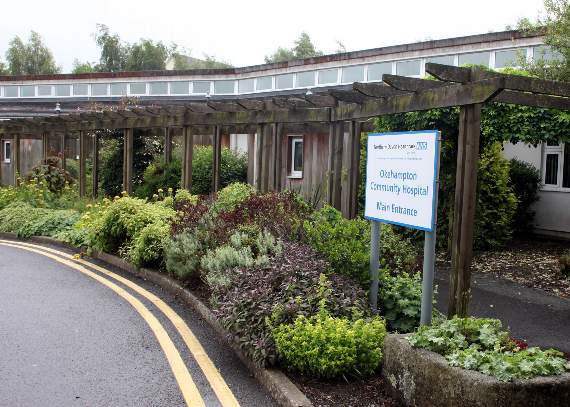
THE proposed closure of all 16 in-patient beds at Okehampton Community Hospital was described as ’disgusting’, ’unfair’ and ’outrageous’ at a town council meeting held last night solely to address the plans.
Okehampton Town Council held an extraordinary meeting last night (Monday, October 3) to discuss Northern, Eastern and Western Devon Clinical Commissioning Group’s (NEW Devon CCG) decision to launch a consultation on cutting half of the community hospital in-patient beds across its eastern locality.
The CCG is considering four options which would keep beds at Tiverton Hospital and two other hospitals out of Sidmouth, Exmouth, Seaton or Whipton. All four options mean Okehampton Hospital would lose all its in-patient beds.
The fate of the hospital was discussed at length by council members, who have now hatched a multi-faceted action plan in an effort help save the hospital beds.




Part one of this action plan was put into motion last week when the ’Save Our Beds - Okehampton Hospital’ Facebook page was created and a large protest of around 200 people was held outside of the hospital on Saturday morning.
Town mayor Cllr Jan Goffey said: ’The four options are like asking us whether we would like to be beheaded, drowned, starved or hung! All of the options inevitably give the same outcome. All of these options proposed by the CCG mean that we will lose our hospital beds. It is appalling.’
Cllr Dave Weekes said: ’Looking at the local area, Okehampton is the only hospital smack-bang in the middle of Devon. Travelling to these other hospitals is extemely difficult for a lot of people, especially those who do not have easy access to transport. I think that what the CCG are doing is disgusting.’
Okehampton Town Council plans to continue sending letters to NEW Devon CCG objecting to the consultation, on the basis that keeping the in-patient beds at Okehampton Hospital has not been included as an option. Additionally, the council has planned a petition which will be taken to Westminster once it has collected enough signatures.
The council intends to create a campaign leaflet which will be delivered to Okehampton residents. The leaflet will highlight the current issue, the town council’s stance on the matter as well as advise residents on what they can do to assist the campaign to save the hospital beds.
The council intends to use this leaflet as a way to encourage previous patients and their families to share their personal experiences of how the hospital has benefited them. The council hopes to gather enough case histories to strengthen their argument.
Cllr Jan Goffey added: ’We need anecdotal evidence from families and patients; it is crucial we get facts. We need example case histories from local people who can prove we need our hospital beds.
’As an action point, we need to round up as many examples from patients and their families. We need evidential proof of the impact it will have to local people if we lose our beds. We need to keep the pressure on by reminding everyone of how crucial these hospital beds are. We need to keep bombarding the CCG until we are heard.’
Cllr Julie Yelland said: ’If there is evidence that people need these beds, then this will strengthen our case. We know there are currently 16 beds in the hospital, however the hospital has the compactly for more.’
During the meeting Cllr Tony Leech gave a report of a meeting he had with NEW Devon CCG: ’To summarise, the meeting the CCG claimed that they went through all of the correct procedures and tick lists. Somebody at the meeting had asked whether Okehampton could be seen as a special case, but they said that the situations has been handled robustly.
’We need to prove that their ethos is flawed. A lot of decisions seem to have been made without consultation. The CCG have said that their ethos is about getting older and frailer people back into their own homes where they can live in comfort.
’They also stated that hospital floors are harder and hospital layouts are unfamiliar to elderly people so they are less likely hurt themselves in their own homes. They said that the new system will include rapid treatment response teams to address patients in their homes, however the logistics of this are questionable.’
Cllr Paul Vachon said : ’Boundaries have clearly been set by higher government. This new system, as I am calling it, the flying doctor scheme, is without doubt just a cost-cutting exercise. We need to publicise what we are feeling, we need to keep our issue at the top of people’s agendas.’
The money raised by the people of Okehampton to help fund the construction and equipment of the hospital was also raised. Cllr Goffey said: ’The public have raise concerns in regard to the £19,000 raised to by the people of Okehampton which went towards buying hospital equipment. I was told that this money was gifted to the NHS, which means there no legal comeback on this money.
’There is no legal obligation, however there should be a moral obligation on this matter. The Okehampton hospital hasn’t been given as an option, therefore Okehampton isn’t part of the consultation. Our hospital hasn’t been given a fair chance.
’The document from the CCG was inaccurate about the population and inaccurate about the number of beds, there have bound to be more inaccuracies made by the CCG.
’Apparently it is four times more expensive to keep patients in hospital. Care in the home is all very well providing the persons home is a warm, safe and secure. If you had a 92-year-old women living in a cottage on her own in the middle of nowhere, this is neither a safe nor secure environment.
’It has also occurred to me that when people are back in their own homes, the cost for this care would come from the social care budget and not NHS money.’
In the NEW Devon area, local health and social care organisations are facing a financial shortfall in 2015/16 of £122-million, which will rise to £384-million in 2020/21 if nothing changes.
The CCG argues that at the same time, many people are in hospital beds who could be cared for at home. They say that with the right care, people can be supported to be in their own home, and this is their goal.
In order to deliver this model of care where more people receive proactive support in their own homes, avoiding hospital admissions and getting home from hospital sooner, the CCG needs to increase the number of staff in the community teams.
To achieve this it needs to take the skills, expertise and resources from delivering inpatient care to delivering care in people’s homes.
The model has three key aspects to it:
A comprehensive assessment – this identifies people who are frail or becoming frail, and therefore are at risk of being admitted to hospital, and puts a care plan in place for them which sets out possible routes for escalating care when needed.
Single point of access – when additional support is needed, a single point of access, connected to a comprehensive care at home service, will help people to remain at home with support, rather than being admitted to hospital.
Rapid response (care at home) – when someone does need to go to hospital they will be helped to leave as soon as it is clinically safe to do so, with additional support provided at home including health and care workers delivering rehabilitation alongside traditional care.
The governing body of the CCG will has agreed upon a public consultation on the plans will run over 13 weeks, expected to start on October 7 and run to January 6, 2017. Full papers and information about the governing body meeting are available on the CCG’s website www.newdevonccg.nhs.uk.
Comments
This article has no comments yet. Be the first to leave a comment.