
BEING severely disabled is bad enough without having to fight the bureaucracy to get help.
It was this situation which made Kath Barr of Okehampton take up the new option of managing her own care offered by Devon County Council.
This has brought a big change for the better for her.
She was very seriously injured in a car crash 17 years ago and spent two and a half years in hospitals in Warwickshire, London, Stoke Mandeville and finally Exeter.
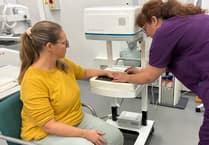



As a tetraplegic she was discharged into the care of her family and later of the county council. Her two children and stepchild are grown up; none of them lives close to her and they all have busy lives, so she is wholly dependent on care services.
For the past eight years she has lived in a ground floor flat in Station Road, which has been specially adapted for her.
She is in a wheelchair and only has the use of one hand, so she needs 24-hour care, but she was not getting it.
The government's Independent Living Fund, which had been supporting her since her accident, could not cover her growing needs and its payments were very strictly monitored.
Until four months ago she was very dissatisfied with the support she was getting.
'Social Services were reviewing my case for months. I went into hospital again for surgery and when I came out they and the ILF took 11 weeks to decide what to do with me. Which purse was the money going to come out of?
'I was not getting the money and my carers were having to work for nothing. The quality of care was poor, mainly due to the management. I didn't know who might walk in that door. I wondered what they would be like and what they would do to me.
'Some of them were not people who I trusted to be carers, sometimes they frightened me. There were too many different people calling. When you are disabled you feel very vulnerable and you must be able to trust your carers.
'But it was suggested to me that I had better put up with this, otherwise I could be put into a home. There was a lot of aggravation and stress.'
Her physical condition worsened last year and she needed more and better care. Then she was told that she could take over her own care under the Direct Payments Scheme, which was launched in 1998.
Around 40 other disabled people in the county, including four in West Devon, have made the move. She was pleased by the way Social Services arranged her transfer.
She has now dispensed with some of the agencies which had been looking after her and hired others.
'As soon as I went on to direct payments, things changed for me. I gained freedom and control and independence. The money goes into my bank account and I decide what to do with it. I can go to the cinema or shopping or ice-skating when I want to. My quality of life is better and I am happier.'
She now has half a dozen carers, chosen by her, and says she loves them all. 'They are my family.'
She said she would recommend the direct payments scheme to others. 'Of the choices we have at the moment it is the best. The people I know who have chosen it all like it. I hope the government leaves it alone, because it is working.'
Despite her worsening condition Kath does not sit and feel sorry for herself. Since her accident she has trained as a psychotherapist and has gained diplomas in the subject.
She has lectured in psychotherapy and psychology at several universities and has written articles for specialist magazines.
She has private clients for psychotherapy and counselling. She uses a computer with a voice recognition input system and communicates by email. She designed her own car with all the controls on a single panel.
At present she is working on an autobiography which she hopes to finish this year. It should be worth looking out for.