

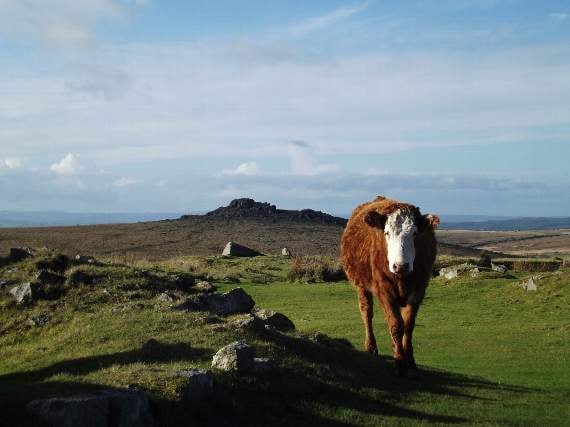
The organisation which represents farmers on the moor has made a plea to visitors to treat Dartmoor with respect this summer.
The Dartmoor Commoners’ Council says it is making ‘ten straightforward requests’ to visitors to help protect Dartmoor’s peace, wildlife and beauty.
Unsurprisingly, the scourge of sheep worrying is at the top of the list.
People are urged to keep their dog under close control, preferably on a lead, and keep their distance from the cattle, sheep and ponies roaming and grazing on the moor.


This leads into a request to avoid feeding the ponies, which like the cattle and sheep belong to various farmers.
Drivers are being asked to ‘kill their speed’ and drive with care to avoid collisions with stock on the moorland roads.
There are no litter bins on the moor, so people are asked to take their dog poo bags home, and not to leave them discarded in the bushes. ‘Our animals cannot digest plastic and toxic waste and ingesting such waste can be fatal,’ said a Dartmoor Commoners’ Council spokesperson. Visitors are asked to use designated parking areas and to avoid blocking farm and field entrances as well as tracks. Cyclists should stick to bridleways, permitted routes and roads and not ride over open moorland. Camping stoves and barbecues should not be used to avoid causing a fire.
Wild camping — backpack camping — is permitted under Dartmoor National Park guidelines in certain areas of the open moor, which can be found on the Dartmoor National Park Authority website. Alternatively, there are plenty of campsides, including a number of ‘pop up campsites’ this summer only. Owners of motorhomes and caravans are also being urged to use campsites, rather than pull up overnight in laybys and car parks. Visitors are also being urged to support the Dartmoor economy by ‘buying local’.
Vice chair of the Commoners’ Council Layland Branfield said: ‘Dartmoor is a living and working landscape and we have the privilege of enjoying it daily whilst running our businesses. The stock (cattle, sheep and ponies) owned by the Commoners are key to the delivery of a wide array of public benefits. The mix of grazing creates a diversity of vegetation and maintains the open landscape of the Dartmoor Commons that attracts many visitors. We ask that visitors respect the area with a few common-sense requests.’
Comments
This article has no comments yet. Be the first to leave a comment.