

VOLUNTEERS are being invited to take part in excavations at Fingle Woods which could unearth secrets of its 3,000-year-old Iron Age history.
The archaeological dig takes place at the ancient woodland site between Monday, April 9 and Saturday, April 21
The Fingle Woods project – led by owners the National Trust and Woodland Trust charities and made possible thanks to £730,000 of National Lottery funding from the Heritage Lottery Fund (HLF) – will carry out an archaeological excavation at Wooston, home to an internationally recognised Iron Age Hillfort, Wooston Castle.
The charities are looking for volunteers to assist with the excavation, particularly people with previous experience of digging. There will also be a public open day on Saturday, April 21 from 11am to 3pm with tours of the site, hands on activities and information about the excavation findings.



More details of the open day can be found on the Fingle Woods blog at finglewoods.org.uk.
For many years the hill fort remained hidden by advancing nature but recent clearances of conifer and bracken have opened it up, bringing archaeologists unprecedented access to delve further into the history at this precious Devon site.
Bryher Mason, National Trust heritage manager for Dartmoor, said: ‘It is an amazing opportunity to investigate a little understood hillfort structure and we are particularly keen to identify a date for the occupation of the site.
‘We should also be able to begin to understand more about the construction of the hill fort. There is also a possibility that we might be able to identify activities which were undertaken on the site (such as metalworking, crafts or animal husbandry).’Experts will use small hand shovels and mattocks to delicately chip away at the site. The hill fort has a dramatic position high above the river in the Teign Valley, with commanding views to the west along Teign Gorge and beyond, towards Dartmoor and also to the rolling landscape to the east.
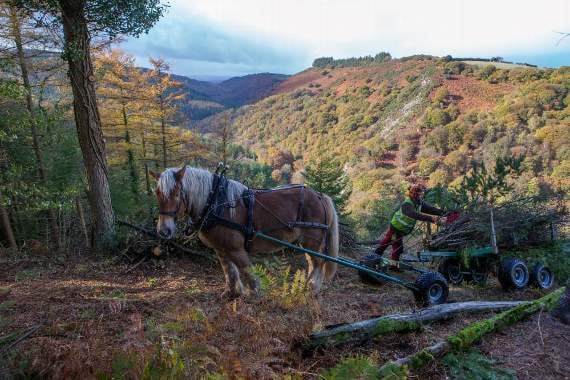
Utilising teams of horse loggers, the charities carefully extracted vast quantities of timber in order to protect the fragile archaeology that had been hidden by nearly a century of coniferous forestry planting.
Wooston is a relatively unusual hill fort as it does not sit right on the top of the hill. The tree clearance has demonstrated the strategic nature of the site where a huge expanse of landscape would have visible to the people who used it.
However, the remains of the hill fort’s banks and ditches are confusing and unconventional, leading to much speculation on the true nature of this fascinating site.
In 2017, the Wooston hill fort was surveyed using geophysical techniques to assess the likelihood that archaeological deposits had survived the forestry activity of the 20th century.
The site was assessed using two techniques, magnetometry and resistivity. Magnetometry is a technique which measures and maps patterns of magnetism in the soil. Ancient activity, particularly burning, leaves magnetic traces that show up even today when detected with specialist equipment.
Resistivity is a form of geophysical survey where electrical current is passed through the ground at regular points on a survey grid.
Electrical resistance in the soil varies, and is affected by the presence of archaeological features. The patterns of resistance in the soil are then recorded, plotted and interpreted.
Anyone interested in volunteering or who would like more information about the project is invited to email [email protected].
Comments
This article has no comments yet. Be the first to leave a comment.