
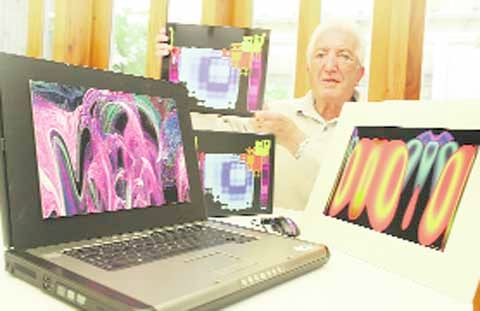
PROVING that there is life after stroke is Tavistock man Monty Shulberg who took up painting around seven years ago as a form of therapy.
Monty, formerly of Mary Tavy, has attracted international attention for his abstract artwork but since his second stroke 18 months ago he has developed a new art form which represents his feelings and emotions on a whole new level.
Monty was a consultant audiologist who treated the likes of Yehudi Menuhin, King Juan Carlos and thousands of children worldwide.
But in 1997 it was discovered he had a brain tumour which was operated on in 1998. Soon after the operation Monty suffered from a stroke which left him with many limitations.

Monty said he soon became very frustrated and depressed. It was not until 2001 when his wife brought him back a children's painting kit that he discovered his hidden talent.
Initially finding that water colours and acrylics were insufficient for producing his creative work, he soon turned to the computer's palettes of many colours — CGI (Computer Generated Imagery) — to produce art, which is now receiving wide acclaim.
Eighteen months ago Monty suffered from a second stroke and had to put his work on hold due to depression. But not content with feeling sorry for himself, Monty got back into CGI at the beginning of 2007.
Monty said his art gave life new meaning and he looks forward to each day. He works with a variety of media but said the use of a computer has enabled him to produce even more work.
He is producing his CGI art as fine art, canvases, acrylics, floating frames and an exciting interpretation or rendition of 'murals'.
He said: 'Being a stroke sufferer, it was quite difficult for me to manipulate things and I found that by using the computer screen as a canvas, the mouse as a brush and the software as colour, I am doing the same thing as with paper and brush — it is no different from conventional art.
'This gives me another outlet and there is still so much more I want to explore.
'The one aspect of my work which I think will draw attention is the "mural" aspect. It is a large wall covering (60ins by 90ins) and they are so dramatic.'
Monty said that although the brain tumour and stroke forced him to give up the work he loved, he has never looked back from taking up art as a recovery therapy.
'I think the most important thing about a stroke, or any disability, is that until you accept it, you can't get on with your life.'
To view Monty Shulberg's work visit http://www.montysart.com">www.montysart.com which will be up and running from October 1. For more information email Monty at [email protected]">[email protected]