

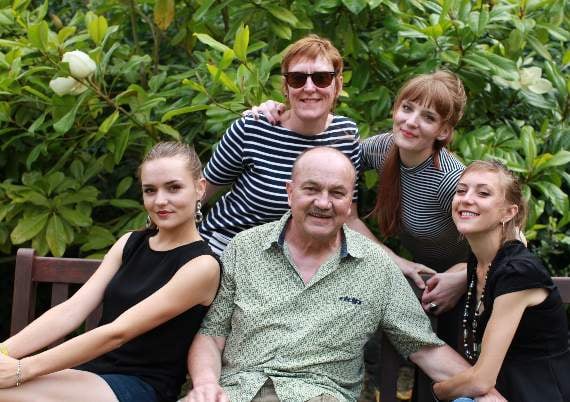
HORRABRIDGE is proud of its French connections, through twinning and other history, and can look forward to telling visitors from across the Channel that the village can claim at least two knights in France’s top honours lists.
Just a few weeks after navy veteran Frank Greep was taken into the Legion d’Honneur for his services to France during the Second World War, another Horrabridge family has had confirmation that one of its members is to become a Chevalier de ‘Ordre Nationale de Merite, which is equivalent in non-military honours.
The medal for Nicola Coulthard, 53, will be awarded in March, probably at the Roman site museum at Vieux-la-Romaine just south of Caen, which grew out of one of the achievements she has been involved in over 35 years in the French civil service.
Mademoiselle Coulthard is head curator of a large archaeological service organising research and developer-funded excavations and managing several heritage sites, including the Roman museum, for the Département du Calvados in Normandy, equivalent to an English county. She is a visiting lecturer at Caen and Reims universities and regularly publishes articles in French and international academic reviews. She is also a member of several museum and heritage management com-mittees.

As with Frank Greep, the citation is for consistent good service rather than any one outstanding achieve-ment.
Nicola is proud of that. She said: ‘I never had ambitions to be Number One. I think I am more collectively minded. When I was at Horrabridge Primary School, I got the Civics prize but the one that mattered most to me was the Isobel Rowe Award, because it was voted for by the pupils.
It was back around the age of eight that one of the old I-Spy books switched Nicola on to archaeology and she realised it was what she wanted to do.
During her teenage years at Tavistock School, her parents, Jean and John Coulthard, drove her to archaeology camps in Scotland, Wiltshire and the Welsh borders, during school holidays. She got a degree in archaeology from University College London (and colours for playing rugby) and met a French boyfriend (now husband), Denis Requier, a sound and lighting engineer, through Horrabridge’s twinning activities.
She met him again during field work in France and after graduating, she picked up a job near where he lived, in the new-born archaeological service of the council she has worked for ever since.
Her first assignment was to dig on Roman sites at Bayeux. Then she directed a 10-year dig at a Roman villa. She was also active in the development of ‘rescue archaeology’, meaning getting in ahead of construction work where there is likely to be something to preserve.
Since becoming head of the service in 2008, Nicola has also developed access for the public at Vieux-la-Romaine, famous for its finds, including a Roman ‘curia’ or council chamber — the only one left visible from the old Roman kingdom of Gaul, covering parts of France and Belgium.
‘It was a small territorial capital for the Romans, similar to others, but whereas most places like it got destroyed by later development, the settlement there remained small over the centuries, so the Roman buildings are exceptionally well preserved,’ she explained.
Nicola has helped turn the site into a well regarded attraction for tourists and educational outings and is herself regarded as something of an expert on the Iron Age and the old kingdom of Gaul.
She was nominated for the medal by the French Ministry of Culture, for long-term work for the community good.
Comments
This article has no comments yet. Be the first to leave a comment.