
Note: This article features a powerful account of the Aberfan disaster that involved the death of many children.
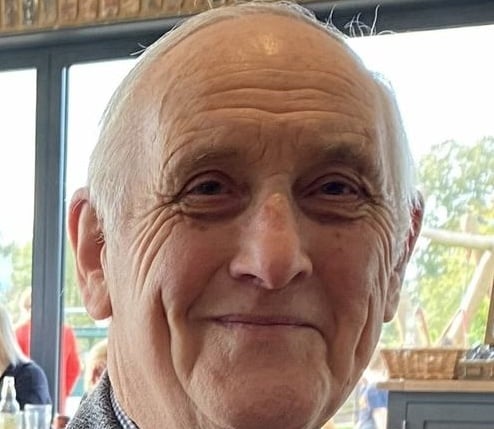
A Methodist minister now living in Okehampton has been looking back this week to the tragedy of Aberfan 60 years ago, writes Jon Hebditch.
The Revd Irving Penberthy, who is now 96, travelled to Aberfan in South Wales earlier this week for the 60th anniversary commemorations of the disaster, attended by the King and Queen and Prince of Wales.
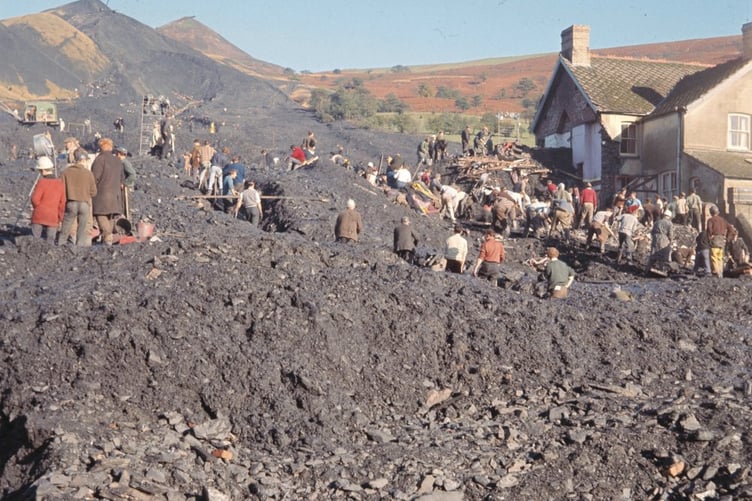
As a young man, Revd Irving saw the horrific aftermath after a massive slag heap collapsed and engulfed Pantglas Junior School in the village on October 21 1966, claiming the lives of 116 children and 28 adults.
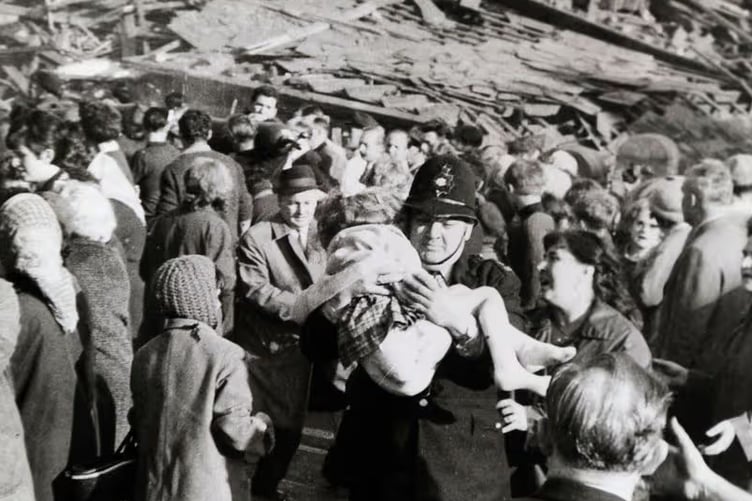
Along with rescue teams, the Revd Irving watched as bodies were pulled from the rubble and taken to the local Bethania Chapel, serving as a makeshift mortuary, where they were then identified by heartbroken parents over the coming days.
The Revd Irving, who lived in nearby Merthyr Tydfil at the time, was driving that morning when he saw emergency vehicles heading to Aberfan.
He said: “I set out about 9am from Merthyr Tydfil to go to Pontypridd and passed the junction for Aberfan on the way.
“One or two emergency vehicles passed me by, but I didn’t take much notice as that often happened if there was an accident at the colliery, so I kept going.
“But a thought kept occurring – ‘you must turn back’. Looking back on it, I’d say it was the voice of God.
“Eventually I did turn around and go back. Of course, the police were there, and I was allowed through to the village because I had my dog collar on – it is useful sometimes.
“I realised something was wrong then; I realised the tragedy of it all. There was such an activity as people had come right away and were digging away at the ruins of the school.
“At the time, we didn’t know the nature of this slurry, and we had hopes that with all this digging the children would be rescued. But as the day went on, we realised this was a serious disaster and saw the little bodies coming into the chapel.”
Then aged 35, and the minister of the Zion Methodist Church in Aberfan, the Revd Irving knew many of the children personally as members of his Sunday School and cried with parents as they found out their children had been killed.
He told how memories of parents searching for their children’s bodies still bring him to tears 60 years on.
He said: “People were just standing around and all we could do was stand with them and try to comfort them.
“It was the fathers who went into the chapel to identify the children, and they were the fathers of our Sunday school children, so I knew many of them.
“I went in with them to identify their children and that was the most traumatic experience of all. When they lifted the blanket and found their little child they burst into tears and I burst into tears with them.
“We couldn’t say anything, it wasn’t the time for words. I called it ‘the ministry of tears’.
“As I talk about it I still feel the tears coming up. It’s something I shall never forget.”
Heavy rain in the first weeks of October 1966 had led to a build-up of water within the coal tip which caused it to suddenly slide downhill and onto the school and nearby homes on October 21.
Emergency services, as well as miners from the Aberfan colliery, raced to the scene after residents rang to report the disaster at around 9.25am.
Nothing could have prepared the young minister for what he would witness in the coming days, despite tragic incidents being all too common in the Welsh coal mines.
He added: “The valleys were used to accidents in the collieries, but this was something completely different. I was there through the night as people were going into the chapel to identify their children.
“The people that I went to were parents of the Sunday School children and all we could do was hold their hand and try and say a word of comfort.”
A wide-ranging tribunal was brought following the disaster and, later, legislation in 1969 brought new rules improving the safety of coal and quarry tips.
Merthyr Vale Colliery closed in 1989 and later so did the Methodist Chapel.
Retiring to Okehampton some years ago, the Revd Irving has often returned to Aberfan to commemorate the disaster.
And, ten years ago, he was met by some of the survivors, who remembered him decades on.
He said: “I go mainly for the surviving children. It was hard not only for those who perished but for those who survived. I went back on the 50th anniversary and several older women came up to me and asked for a hug. They remembered me from all those years back. It was very touching.
“One of the thoughts that always comforted me at the time, with such a large loss of children, was Jesus saying ‘let the children come to me, and do not hinder them. For of such is the kingdom of heaven.’
“‘Unless you become like children, you will never enter the kingdom of heaven.’
“So for me, the children are gone to be with Christ in their innocence. Our advice was for people to keep in touch with heaven.”
Comments
We've recently changed our login process. If you have an account for commenting, you will need to re-register on the login window.
This article has no comments yet. Be the first to leave a comment.