

FOUR months after the Beast from the East saw gritters hit the roads of Devon to protect the county from snow and ice, they were back out on the roads last Friday tackling record road temperatures.
Surface temperatures on roads in Devon have reached as high as 60°C – ten degrees higher than the temperature at which road surfaces can start to melt.
A Devon County Council spokesman said as a precaution the authority had applied fine sand to help prevent the bitumen from becoming soft and had been monitoring all main roads across the county particularly those that had recently been surface dressed or are in exposed areas.
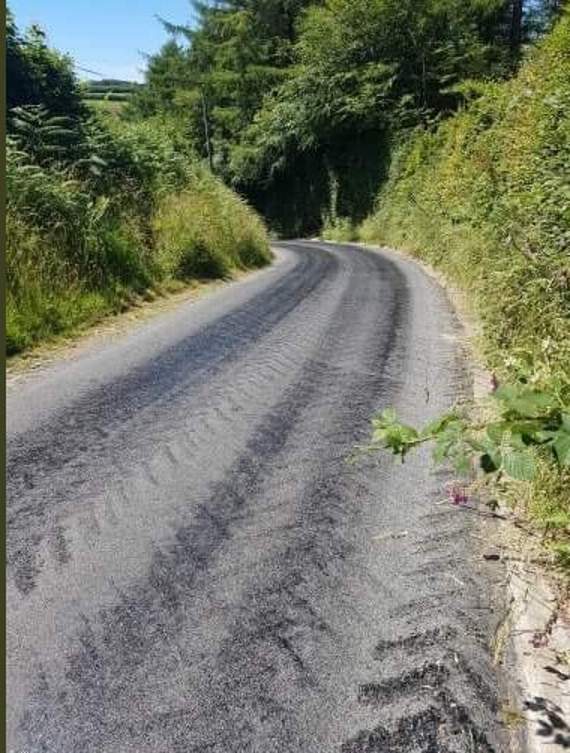
The heatwave has resulted in roads across the county melting. The picture shows a road near North Molton where the tarmac had started to melt and were shared as a warning to try and keep post office workers and members of the public on the roads safe. Up to eight heatwaves are forecast in July and August with temperatures forecast to hit 34C.



Tarmac becomes soft at 50C, and while the air temperature is much lower, the roads can become that hot in direct sunlight.
Speaking last year, Howard Robinson, chief executive of the Road Surface Treatments Association, said that when temperatures top 30C, the bitumen in some road surfaces may soften and rise to the top.
He said: ‘This makes the road surface sticky and more susceptible to pressure loads from heavy vehicles resulting in surface ridging and rutting.
‘Most roads will not begin to soften until they hit a temperature of around 50C.
‘However, even a sunny day in the 20Cs can be enough to generate 50C on the ground as the dark asphalt road surface absorbs a lot of heat and this builds up during the day.
‘The response for local highway authorities is to send out the gritters to spread granite dust or sand to absorb the soft bitumen and so stabilise the road surface and make it less sticky.
‘Drivers may be bemused to see the gritters out in the summer when they are usually spreading grit and salt during the winter.
‘However, this is effective standard practice for keeping a road surface safe during extreme hot temperatures.’
He continued: ‘Asphalt is like chocolate – it melts and softens when it’s hot, and goes hard and brittle when it’s cold – it doesn’t maintain the same strength all year round.’
Jack Cousens, the head of roads policy for the AA, said: ‘While many drivers will seek some fun in the sun, our road network will be desperate for some shade.
‘Drivers may get a surprise as the gritters make a return to our streets. However, rather than spreading salt, they will be dusting sand on the roads as a form of sunscreen for the tarmac.’
Comments
This article has no comments yet. Be the first to leave a comment.