

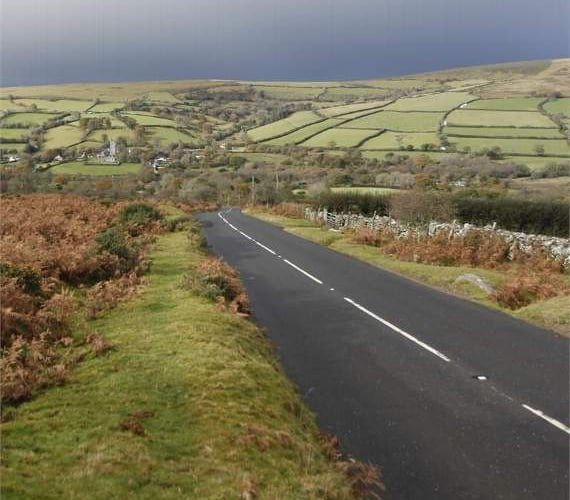
MORE should be done to enforce speed limits on Dartmoor, a Government review of England’s national parks has been told.
The plea comes after the Dartmoor Livestock Protection Society reported a rise in the number of animals killed on Dartmoor’s roads in the past year.
The Open Spaces Society, Britain’s leading pressure group for common land, made its comments to the current Government’s review of England’s national parks and areas of outstanding natural beauty (AONBs), led by Julian Glover.
There were 191 accidents on Dartmoor’s roads during 2018, with 158 animals killed and 33 injured.

.jpeg?width=209&height=140&crop=209:145,smart&quality=75)

Kate Ashbrook, general secretary of the Open Spaces Society, said: ‘We oppose the fencing of roads across commons because this restricts public access and is a blot on the landscape. We consider it is much better to slow the traffic.
‘This would also encourage motorists to appreciate that national parks and AONB are special places which are not to be rushed through but such speed limits must be enforced or they will be ignored.
‘National park authorities and AONB boards and committees should be given the power to impose speed limits on unfenced roads across commons, as though they were the traffic authorities.
‘The limit should be as low as 20 mph in some places. We would like to see sympathetically-engineered traffic-calming measures introduced as well.’
She noted that a 40mph limit already applied to roads across the Dartmoor – and yet the death toll on the roads had risen in the past year.
‘There are already speed limits on some commons, on Dartmoor and in the New Forest for instance, but they are too often ignored and need greater enforcement.
‘We would argue for speed limits wherever there is an unfenced road across common land—in the North Pennines, Bodmin Moor, the Malvern Hills and Gower AONBs and the North York Moors and Brecon Beacons national parks, to name a few examples.
‘It would be a great idea to pilot this idea in the national parks and AONBs.
‘On Dartmoor, even where there is a 40mph speed limit on many roads across the commons, the Dartmoor Livestock Protection Society reports that in 2018 there were a shocking 191 accidents involving livestock, with 158 animals killed and 33 injured.
The excellent DLPS urges people to drive with care for animals, but clearly the speed limit has to be enforced in order to slow the traffic.
‘We hope that the Glover Review will adopt our proposal as this would give it considerable weight.’
However, Andrew Watson, head of access and recreation at Dartmoor National Park Authority, said he felt that a speed limit as low as 20mph would not be enforceable on Dartmoor’s roads.
‘I think practically speaking if they were to impose a 20mph limit in the national park, people would completely ignore it.
‘On the long straight road between Moretonhampstead and Postbridge and beyond, for instance, getting people to stick to 20mph would be quite difficult.’
He also said it was not necessary that the national park takes over powers for setting speed limits on the moor.
‘Devon County Council sets the speed limits on the road network and as things are at the moment we work pretty closely with the county council anyway, so I’m not sure we would need additional powers to do that.’
He queried, too, whether physical traffic calming measures would be effective on Dartmoor roads.
‘I think that from a highways engineering point of view, putting speed bumps on roads would be more difficult, and I’m not sure it would be something they would want to do.’
However Dartmoor Livestock Protection Society livestock protection officer Karla McKechnie, who is on call 24/7 to go to stricken livestock on the moor, said she welcomed anything that would encourage drivers to slow down.
‘We are getting drivers coming on to the moor and just switching off,’ she said.
‘They are not expecting there to be animals, and sadly the manpower of the police is less than it used to be and it is just not being enforced.’
The recent Dartmoor Speedwatch, a community effort to monitor the speed of traffic on three roads from Princetown, saw livestock deaths reduced on those roads because people slowed down, she added.
Overall across the moor the death toll of livestock rose by 30 per cent in 2018.
Comments
This article has no comments yet. Be the first to leave a comment.