
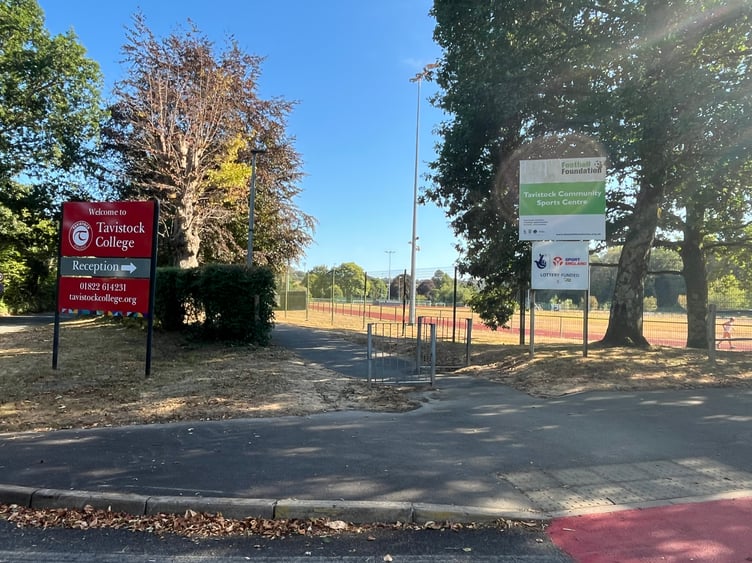
Concerns over sewage spills next to a site where children play sport in Tavistock have been exacerbated by the news that mitigation measures are not expected to happen until 2028.
South West Water says no short term or immediate action is currently planned at the Tavistock College Playing Field combined sewer overflow (CSO) on Crowndale Road which was one of the River Tavy pollution hotspots last year.
The monitoring station at the site, which is part of the college campus but also used by the local community, recorded 80 sewage dumps into the river last year lasting 500 hours.
At the nearby Crowndale Cottages CSO 72 spillage events were recorded and 79 at Westbridge Cottages which were all among the worst areas for sewage overflows along the River Tavy.
Local resident Jay Henson said he was “appalled” after a response from South West Water to his Freedom of Information (FOI) request.
Although the water company said in its response that the combined sewer overflows at Tavistock College Playing Field and Westbridge Cottages are both included in its investment programme, with the objective of reducing discharges to no more than ten spills per year on average, this will not be until March 2028.
SWW says it is undertaking hydraulic modelling of the catchment over the next three months to identify the root cause of spills.
It has declined to disclose the specific infrastructure upgrades that are currently proposed or being considered because it says it is not in the public interest at this stage.
Investment at the Crowndale Cottages CSO is not expected before 2030-2035.
Jay said he was horrified that there was no immediate action planned to protect students, families, sport users or the public while sewage spill investigations continue.



“An active educational and community sports site can continue to be affected by sewage spills, there is no short term protection planned, and the public is being told to wait years for answers.” he exclaimed. “Meanwhile, we continue paying ever increasing water bills.
“This is not about one spill. It’s about a sewage infrastructure system that residents are expected to tolerate while decisions are delayed and communities are left with uncertainty.”
He said he was unhappy that SWW’s goal was not to eliminate sewage discharges completely.
“Their stated target is to reduce them to an average of ten spills per year. These spells could last multiple weeks!” he said.
According to public interest website Top of the Poops, which processes public data released by the Environment Agency, the River Tavy was polluted by sewage 572 times in 2025 lasting 3,738 hours at nine sites.
The most recent data from Safer Seas and Rivers (SSRS) shows that there have been 104 sewage discharges at the Tavistock College Playing Field CSO so far this year, with July 19 being the last one.
Jay claims that much of the sewage dumping is occurring during dry spells.
“It a shame that there isn’t any way to prove that but as a Tavistock resident that pays a lot of attention to this matter I would say around 40% of it happens in dry spells,” he said.
People have shared stories on social media of children getting ill after swimming in the River Tavy and the River Walkham.
One person responding to Jay Henson’s post said their daughter was hospitalised after swimming at Grenofen a month ago.
Another said sewage was “everywhere”.
“The sewage overflow going into the Tavy by the footbridge in the Meadows (park) has discharged 97 times this year. I have reported it to SWW and the Environment Agency and it is still regularly discharging every time the sewage system overflows even with no rain.”
Comments
This article has no comments yet. Be the first to leave a comment.